Effects of Human Umbilical Cord Mesenchymal Stem Cell-Derived Exosomes on an Ischemic Stroke Rat Model
Article Sidebar
PDF downloads: 143
XML-Crossref downloads: 42
XML-DOAJ downloads: 44
Crossref Citations: 0

Main Article Content

Abstract
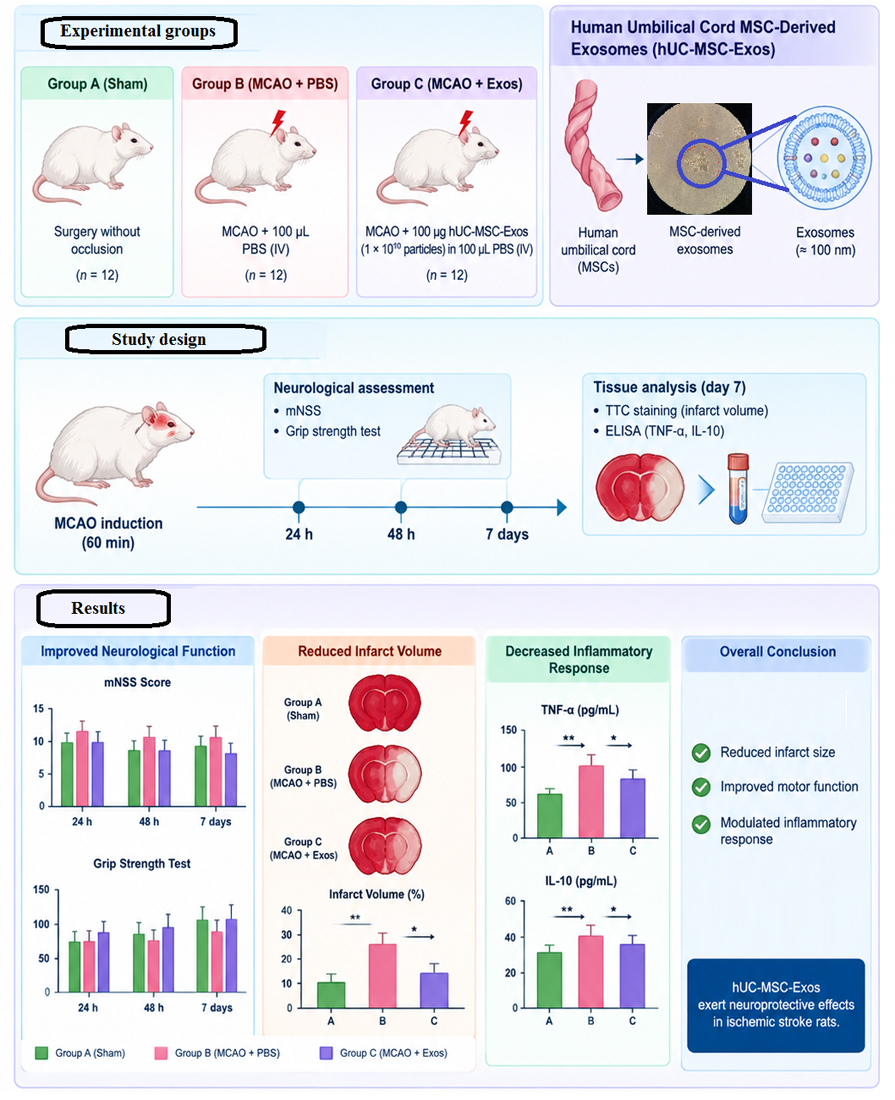
Introduction: Ischemic stroke remains a leading cause of disability worldwide, with limited therapeutic options beyond the acute stage. Mesenchymal stem cell (MSC)-derived exosomes have emerged as a promising cell-free therapeutic strategy due to their immunomodulatory and neurotrophic properties. The current study aimed to evaluate the neuroprotective effects of human umbilical cord MSC-derived exosomes (hUC-MSC-Exos) on neurological function, infarct volume, and inflammatory response in a rat model of middle cerebral artery occlusion (MCAO).
Materials and methods: A total of 36 adult male rats weighing 250-300 grams and aged 8-10 weeks were randomly divided into three groups of 12 rats each. The first group underwent surgery without occlusion (Group A). The second group consisted of MCAO rats that received 100 µL of phosphate-buffered saline (PBS) intravenously (Group B). The third group consisted of MCAO rats that received 100 µg of hUC-MSC-Exos (1 × 10¹⁰ particles), diluted in 100 µL of sterile PBS, administered intravenously (Group C). Ischemic stroke was induced by 60-minute transient MCAO followed by reperfusion. Neurological deficits were assessed using the modified neurological severity score (mNSS) and grip strength test at 24 hours, 48 hours, and 7 days post-stroke. On day 7, brains were harvested for 2,3,5-triphenyltetrazolium chloride (TTC) staining to measure infarct volume, and cortical tissue was collected to measure tumor necrosis factor-alpha (TNF-α) and Interleukin-10 (IL-10) levels by enzyme-linked immunosorbent assay (ELISA).
Results: Administration of 100 μg of hUC-MSC-Exos significantly improved neurological function compared To Group B, as evidenced by reduced mNSS scores from 12.4 ± 1.2 to 11.8 ± 1.4 in 24 hours, from 11.2 ± 1.3 to 8.3 ± 1.1 in 48 hours, and from 9.6 ± 1.5 to 4.5 ± 0.9 on day 7, along with increased grip strength. Moreover, TTC staining revealed a significant reduction in infarct volume in Group C compared to the control group. The pro-inflammatory cytokine TNF-α and IL-10 in the ischemic cortical tissue in Group C were significantly decreased compared to Group B.
Conclusion: The systemic administration of hUC-MSC-Exos had neuroprotective effects on rats by reducing infarct size, improving motor function, and modulating the inflammatory response.
Article Details

This work is licensed under a Creative Commons Attribution 4.0 International License.
All claims expressed in this article are solely those of the authors and do not necessarily represent those of their affiliated organizations, or those of the publisher, the editors, and the reviewers. Any product that may be evaluated in this article, or claim that may be made by its manufacturer, is not guaranteed or endorsed by the publisher.
References
Pu L, Wang L, Zhang R, Zhao T, Jiang Y, Han L, et al. Projected global trends in ischemic stroke incidence, deaths and disability-adjusted life years from 2020 to 2030. Stroke. 2023; 54(5): 1330-1339. DOI:
1161/STROKEAHA.122.040073
Ahmed Z, Chaudhary F, and Agrawal DK. Epidemiology, pathophysiology, and current treatment strategies in stroke. Cardiol Cardiovasc Med. 2024; 8(4): 389-404. DOI: 10.26502/fccm.92920399
Shi K, Tian DC, Li ZG, Ducruet AF, Lawton MT, Shi FD, et al. Global brain inflammation in stroke. Lancet Neurol. 2019; 18(11): 1058-1066. DOI: 10.1016/S1474-4422(19)30078-X
Sekerdag E, Solaroglu I, and Gursoy-Ozdemir Y. Cell death mechanisms in stroke and novel molecular and cellular treatment options. Curr Neuropharmacol. 2018; 16(9): 1396-1415. DOI: 10.2174/1570159X16666180302115544
Ovbiagele B, Goldstein LB, Higashida RT, Howard VJ, Johnston SC, Khavjou OA, et al. Forecasting the future of stroke in the United States: A policy statement from the American Heart Association and American Stroke Association. Stroke. 2013; 44(8): 2361-2375. DOI: 10.1161/STR.0b013e31829734f2
Herpich F, and Rincon F. Management of acute ischemic stroke. Crit Care Med. 2020; 48(11): 1654-1663. DOI: 10.1097/CCM.0000000000004597
Wu L, Xiong X, Wu X, Ye Y, Jian Z, Zhi Z, et al. Targeting oxidative stress and inflammation to prevent ischemia-reperfusion injury. Front Mol Neurosci. 2020; 13: 28. DOI: 10.3389/fnmol.2020.00028
Fisher M, and Savitz SI. Pharmacological brain cytoprotection in acute ischaemic stroke renewed hope in the reperfusion era. Nat Rev Neurol. 2022; 18(4): 193-202. DOI: 10.1038/s41582-021-00605-6
Fan CG, Zhang Qj, and Zhou Jr. Therapeutic potentials of mesenchymal stem cells derived from human umbilical cord. Stem Cell Rev Rep. 2011; 7(1): 195-207. DOI: 10.1007/s12015-010-9168-8
El Omar R, Beroud J, Stoltz J-F, Menu P, Velot E, Decot V, et al. Umbilical cord mesenchymal stem cells: The new gold standard for mesenchymal stem cell-based therapies?. Tissue Eng PartB Rev. 2014; 20(5): 523-544. DOI: 10.1089/ten.teb.2013.0664
Nagamura-Inoue T, and He H. Umbilical cord-derived mesenchymal stem cells: Their advantages and potential clinical utility. World J Stem Cells. 2014; 6(2): 195-202. DOI: 10.4252/wjsc.v6.i2.195
Gurunathan S, Kang MH, Jeyaraj M, Qasim M, and Kim JH. Review of the isolation, characterization, biological function, and multifarious therapeutic approaches of exosomes. Cells. 2019; 8(4): 307. DOI: 10.3390/cells8040307
Zhang L, Yang F, Liu J, Li M, Mao F, Ocansey D, et al. Exosomes in tissue engineering and cell-free therapy: A comprehensive review. Eur Cell Mater. 2026; 55: 80-105. DOI: 10.22203/eCM.v055a06
Ma ZJ, Yang JJ, Lu YB, Liu ZY, and Wang XX. Mesenchymal stem cell-derived exosomes: Toward cell-free therapeutic strategies in regenerative medicine. World J Stem Cells. 2020; 12(8): 814-840. DOI: 10.4252/wjsc.v12.i8.814
Habib SM, Haider KH, and Martini MF. The potential of mesenchymal stem cell-derived exosomes in cell-free therapy for myocardial repair. Handbook of regenerative medicine. 2025. p. 372-389. DOI: 10.1201/9781003611509-24
Zakrzewski W, Dobrzyński M, Szymonowicz M, and Rybak Z. Stem cells: Past, present, and future. Stem Cell Res Ther. 2019; 10(1): 68. DOI: 10.1186/s13287-019-1165-5
Luan Z, Liu J, Li M, Wang Y, and Wang Y. Exosomes derived from umbilical cord-mesenchymal stem cells inhibit the NF-κB/MAPK signaling pathway and reduce the inflammatory response to promote recovery from spinal cord injury. J Orthop Surg Res. 2024; 19(1): 184. DOI: 10.1186/s13018-024-04651-w
Abbaszadeh H, Ghorbani F, Derakhshani M, Movassaghpour A, and Yousefi M. Human umbilical cord mesenchymal stem cell-derived extracellular vesicles: A novel therapeutic paradigm. J Cell Physiol. 2020; 235(2): 706-717. DOI: 10.1002/jcp.29004
Zhang ZW, Wei P, Zhang GJ, Yan JX, Zhang S, Liang J, et al. Intravenous infusion of the exosomes derived from human umbilical cord mesenchymal stem cells enhance neurological recovery after traumatic brain injury via suppressing the NF-κB pathway. Open Life Sci. 2022; 17(1): 189-201. DOI: 10.1515/biol-2022-0022
Yang Z, Liang Z, Rao J, Xie H, Zhou M, Xu X, et al. Hypoxic-preconditioned mesenchymal stem cell-derived small extracellular vesicles promote the recovery of spinal cord injury by affecting the phenotype of astrocytes through the miR-21/JAK2/STAT3 pathway. CNS Neurosci Ther. 2024; 30(3): e14428. DOI: 10.1111/cns.14428
Chang YH, Wu KC, and Ding DC. Chondrogenic potential of human umbilical cord mesenchymal stem cells cultured with exosome-depleted fetal bovine serum in an osteoarthritis mouse model. Biomed. 2022; 10(11): 2773. DOI: 10.3390/biomedicines10112773
Wang SQ, Jin MJ, Guo ZK, Shen DR, Jin LN, Cheng F, et al. Trace element-dictated exosome modules and self-adaptive dual-network hydrogel orchestrate diabetic foot regeneration through complement-mitochondria-autophagy circuitry. Military Med Res. 2025; 12(1): 71. DOI: 10.1186/s40779-025-00658-4
Wang N, Yin M, Yu J, Zhang J, and Pan X. Comparative investigation of exosome extraction from rat bone marrow mesenchymal stem cells using three different methodologies. Electrophoresis. 2024; 45(21-22): 2045-2053. DOI: 10.1002/elps.202400055
Zhan C, and Yang J. Protective effects of isoliquiritigenin in transient middle cerebral artery occlusion-induced focal cerebral ischemia in rats. Pharmacol Res. 2006; 53(3): 303-309. DOI: 10.1016/j.phrs.2005.12.008
Khalilzadeh E, Azarpey F, Hazrati R, and Saiah GV. Evaluation of different classes of histamine H1 and H2 receptor antagonist effects on neuropathic nociceptive behavior following tibial nerve transection in rats. Eur J Pharmacol. 2018; 834: 221-229. DOI: 10.1016/j.ejphar.2018.07.011
Zeng X, Liao Y, Huang D, Yang J, Dai Z, Chen Z, et al. Exosomes derived from hUC-MSCs exhibit ameliorative efficacy upon previous cesarean scar defect via orchestrating β-TrCP/CHK1 axis. Sci Rep. 2025; 15(1): 489. DOI: 10.1038/s41598-024-84689-2
Xu L, Feng Y, Zheng X, Wang M, Fang Y, Li L, et al. Astragaloside IV-preconditioned neural stem cell transplantation promotes neurogenesis and functional recovery via the miR-199a-5p/Caveolin-1 pathway in a rat model of ischemic stroke. Int Immunopharmacol. 2026; 168: 115898. DOI: 10.1016/j.intimp.2025.115898
Farhadi Moghadam B, and Fereidoni M. Neuroprotective effect of menaquinone-4 (MK-4) on transient global cerebral ischemia/reperfusion injury in rat. PLOS ONE. 2020; 15(3): e0229769. DOI: 10.1371/journal.pone.0229769
Zhang R, Liu Y, Yan K, Chen L, Chen XR, Li P, et al. Anti-inflammatory and immunomodulatory mechanisms of mesenchymal stem cell transplantation in experimental traumatic brain injury. J Neuroinflammation. 2013; 10(1): 871. DOI: 10.1186/1742-2094-10-106
Dunnett SB, Torres EM, and Annett LE. A lateralised grip strength test to evaluate unilateral nigrostriatal lesions in rats. Neurosci Lett. 1998; 246(1): 1-4. DOI: 10.1016/S0304-3940(98)00194-3
Gerriets T, Stolz E, Walberer M, Müller C, Kluge A, Bachmann A, et al. Noninvasive quantification of brain edema and the space-occupying effect in rat stroke models using magnetic resonance imaging. Stroke. 2004; 35(2): 566-571. DOI: 10.1161/01.STR.0000113692.38574.57
Liu N, Chen R, Du H, Wang J, Zhang Y, Wen J, et al. Expression of IL-10 and TNF-α in rats with cerebral infarction after transplantation with mesenchymal stem cells. Cell Mol Immunol. 2009; 6(3): 207-213. DOI: 10.1038/cmi.2009.28
Qiu C, Lindley A, and Jia X. Stem cell-derived extracellular vesicle therapy in ischemic brain injuries. J Stroke. 2025; 27(3): 313-328. DOI: 10.5853/jos.2025.01690
Song J, Zhou D, Cui L, Wu C, Jia L, Wang M, et al. Advancing stroke therapy: Innovative approaches with stem cell-derived extracellular vesicles. Cell Commun Signal. 2024; 22(1): 369. DOI: 10.1186/s12964-024-01752-1
Shen B, Chen J, Liu N, Hou J, and Dai Y. Therapeutic mechanisms of umbilical cord mesenchymal stem cell-derived exosomes in ischemic stroke: A transcriptomic and metabolomic study. Neural Regen Res. 2025; 21(6): 2632-2642. DOI: 10.4103/nrr.nrr-d-24-01219
Barbati SA, D'Amelio C, Feroleto C, Morotti M, Sarrapochiello IN, Natale F, et al. Intranasal delivery of extracellular vesicles derived from human bone marrow mesenchymal stem cells dampens neuroinflammation and ameliorates motor deficits in a mouse model of cortical stroke. Exp Neurol. 2026; 396: 115540. DOI: 10.1016/j.expneurol.2025.115540
Shan XQ, Luo YY, Chang J, Song JJ, Hao N, and Zhao L. Immunomodulation: The next target of mesenchymal stem cell-derived exosomes in the context of ischemic stroke. World J Stem Cells. 2023; 15(3): 52-70. DOI: 10.4252/wjsc.v15.i3.52
Liu J, Pan Y, Wu H, Guo Q, Fang X, Lu Y, et al. hUMSC-derived exosomes alleviate hypoxic cerebrovascular injury via AMPK/NLRP3-mediated pyroptosis suppression and mitochondrial protection. J Biomed Res. 2026; 40(3): 312-326. DOI: 10.7555/JBR.39.20250189
Chen N, Wang YL, Sun HF, Wang ZY, Zhang Q, Fan FY, et al. Potential regulatory effects of stem cell exosomes on inflammatory response in ischemic stroke treatment. World J Stem Cells. 2023; 15(6): 561-575. DOI: 10.4252/wjsc.v15.i6.561