
Etiology, Therapeutic Challenges, Drug Interactions, and Future Directions of Gastric Ulcer Progression to Gastric Cancer
Article Sidebar
PDF downloads: 93
XML-Crossref downloads: 52
XML-DOAJ downloads: 46
Crossref Citations: 0

Main Article Content

Abstract
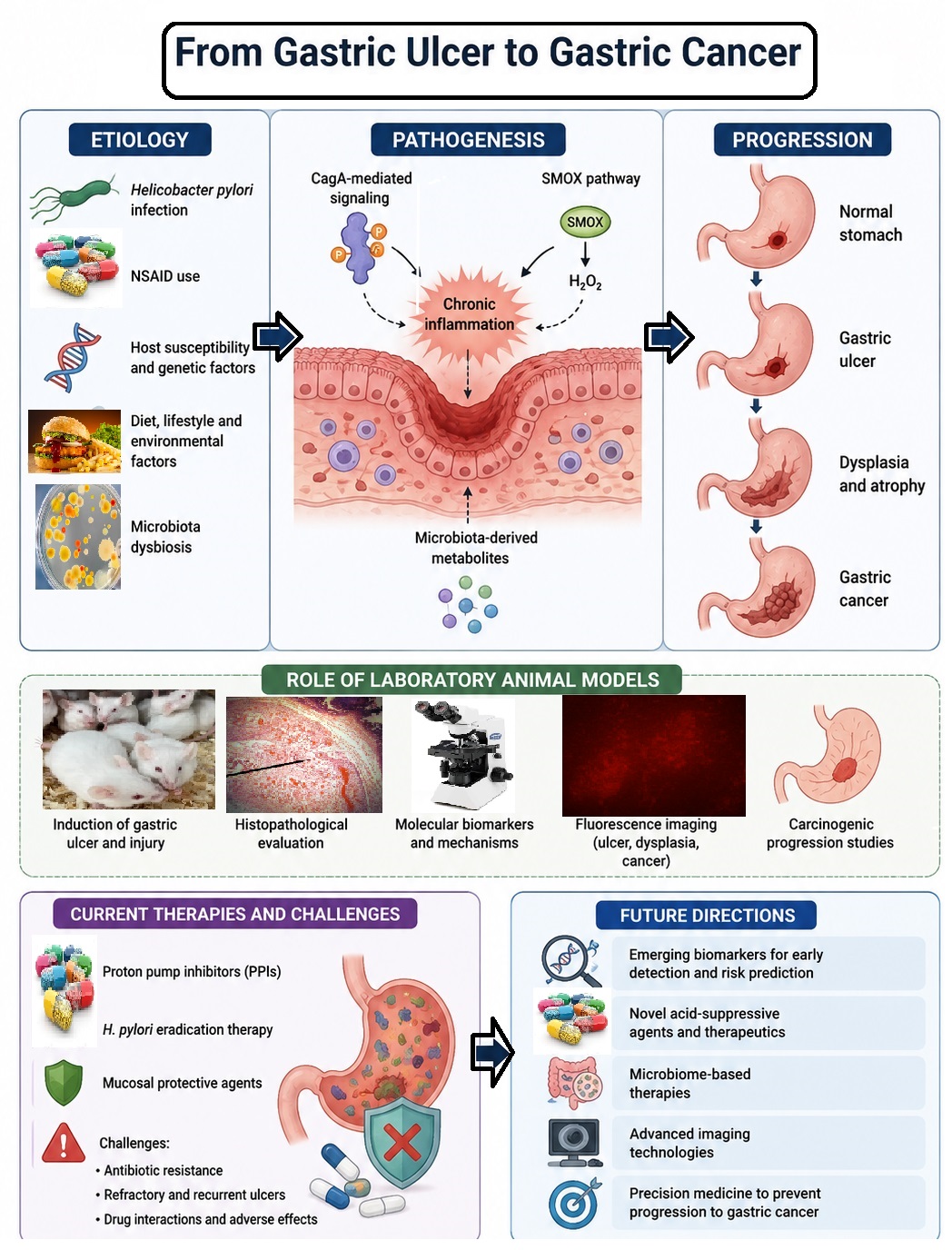
Gastric cancer remains one of the leading causes of cancer-related mortality worldwide, and chronic gastric ulceration represents an important precursor lesion in a subset of patients. This narrative review aimed to synthesize evidence published between 2015 and 2026 on the etiology and pathogenesis of gastric ulcer, current therapeutic strategies, the preclinical roles of laboratory animals, treatment failures, and the transition from gastric ulcer to gastric cancer. The progression from chronic inflammation to malignancy is driven by a complex interplay of bacterial virulence factors, host responses, and molecular alterations. Laboratory animal models have provided important preclinical evidence for evaluating gastric mucosal injury, histopathological changes, diagnostic biomarkers, and carcinogenic progression. In particular, rodent and mouse models have supported the development of molecular and fluorescence-based imaging approaches for detecting ulcerative, dysplastic, and malignant gastric lesions. Helicobacter pylori (H. pylori) infection and prolonged use of nonsteroidal anti-inflammatory drugs (NSAIDs) are the primary etiological factors in the development of gastric ulcer, while host susceptibility, environmental influences, and microbial interactions further contribute to disease progression. Recent advances have improved understanding of the molecular mechanisms underlying gastric mucosal injury, ulcer healing, and carcinogenesis, including CagA-mediated signaling, the spermine oxidase (SMOX) pathway, and microbiota-derived metabolites. Despite the widespread use of proton pump inhibitors and H. pylori eradication diets, increasing antibiotic resistance and refractory ulcers continue to limit treatment success. Emerging biomarkers, innovative acid-suppressive agents, microbiome-based strategies, and advanced imaging technologies present promising strategies for improving diagnosis and treatment. Integrating findings from experimental animal models with clinical evidence could improve diagnostic timing, risk prediction, and the development of targeted strategies to prevent the progression of gastric ulcers to gastric cancer.
Article Details

This work is licensed under a Creative Commons Attribution 4.0 International License.
All claims expressed in this article are solely those of the authors and do not necessarily represent those of their affiliated organizations, or those of the publisher, the editors, and the reviewers. Any product that may be evaluated in this article, or claim that may be made by its manufacturer, is not guaranteed or endorsed by the publisher.
References
Lanas A, and Chan FKL. Peptic ulcer disease. Lancet. 2017; 390(10094): 613-624. DOI: 10.1016/S0140-6736(16)32404-7
Katelaris P, Hunt R, Bazzoli F, Cohen H, Fock KM, Gemilyan M, et al. Helicobacter pylori world gastroenterology organization global guideline. J Clin Gastroenterol. 2023; 57(2): 111-126. DOI: 10.1097/MCG.0000000000001719
Sonnenberg A. Epidemiology of Helicobacter pylori. Aliment Pharmacol Ther. 2022; 55(Suppl 1): S1-S13. DOI: 10.1111/apt.16592
Naumann M, Ferino L, Sharafutdinov I, and Backert S. Gastric epithelial barrier disruption, inflammation and oncogenic signal transduction by Helicobacter pylori. In: Backert S, editor. Helicobacter pylori and gastric cancer. Current topics in microbiology and immunology. Cham: Springer; 2023. p. 207-238. DOI: 10.1007/978-3-031-47331-9_8
Sohail R, Mathew M, Patel KK, Reddy SA, Haider Z, Naria M, et al. Effects of non-steroidal anti-inflammatory drugs (NSAIDs) and gastroprotective NSAIDs on the gastrointestinal tract: A narrative review. Cureus. 2023; 15(4): e37080. DOI: 10.7759/cureus.37080
Avishai E, Yeghiazaryan K, and Golubnitschaja O. Impaired wound healing: facts and hypotheses for multi-professional considerations in predictive, preventive and personalised medicine. Epma J. 2017; 8(1): 23-33. DOI: 10.1007/s13167-017-0081-y
Leja M, Grinberga‐Derica I, Bilgilier C, and Steininger C. Epidemiology of Helicobacter pylori infection. Helicobacter. 2019; 24: e12635. DOI: 10.1111/hel.12635
Thrift AP, and El-Serag HB. Burden of gastric cancer. Clin Gastroenterol Hepatol. 2020; 18(3): 534-542. DOI: 10.1016/j.cgh.2019.07.045
Piscione M, Mazzone M, Di Marcantonio MC, Muraro R, and Mincione G. Eradication of Helicobacter pylori and gastric cancer: a controversial relationship. Front Microbiol. 2021; 12: 630852. DOI: 10.3389/fmicb.2021.630852
Duan Y, Xu Y, Dou Y, and Xu D. Helicobacter pylori and gastric cancer: Mechanisms and new perspectives. J Hematol Oncol. 2025; 18(1): 10. DOI: 10.1186/s13045-024-01654-2
Condur LM, Chirila SI, Alexandrescu L, Iancu MA, Neculau AE, Berariu FV, et al. Proton pump inhibitor use in older adult patients with multiple chronic conditions: Clinical risks and best practices. J Clin Med. 2025; 14(15): 5318. Available at: https://www.mdpi.com/2077-0383/14/15/5318
Ru GQ, Han Y, Wang W, Chen Y, Wang HJ, Xu WJ, et al. CEACAM6 is a prognostic biomarker and potential therapeutic target for gastric carcinoma. Oncotarget. 2017; 8 (48): 83673-83683. DOI: 10.18632/oncotarget.19415
Choi WT, Lauwers GY, and Slavik T. Inflammatory disorders of the stomach. In: Bateman AC, Greenson JK, Lauwers GY, Loughrey MB, Novelli MR, Sheahan K, and Shepherd NA, editors. Morson and Dawson's gastrointestinal pathology. 6th ed. Wiley, 2024. p. 135-194. DOI: 10.1002/9781119423195.ch11
Sokolova O, and Naumann M. Crosstalk between DNA damage and inflammation in the multiple steps of gastric carcinogenesis. In: Backert S, editor. Molecular mechanisms of inflammation: Induction, Resolution and Escape by Helicobacter pylori. Current topics in microbiology and immunology. Cham: Springer; 2019. p. 107-137. DOI: 10.1007/978-3-030-15138-6_5
Reyes VE. Helicobacter pylori and its role in gastric cancer. Microorganisms. 2023; 11(5): 1312. DOI: 10.3390/microorganisms11051312
Wang W, Li Y, Lin K, Wang X, Tu Y, and Zhuo Z. Progress in building clinically relevant patient‐derived tumor xenograft models for cancer research. Anim Model Exp Med. 2023; 6(5): 381-398. DOI: 10.1002/ame2.12349
Chen Y, Hou X, Li D, Ding J, Liu J, Wang Z, et al. Development of a CLDN18. 2-targeting immuno-PET probe for non-invasive imaging in gastrointestinal tumors. J Pharm Anal. 2023; 13(4), 367-375. DOI: 10.1016/j.jpha.2023.02.011
An, F., Zheng, C., Zhang, G., Zhou, L., Wu, Y., Hou, Z., ... & Zhan, Q. (2021). Carcinoembryonic antigen related cell adhesion molecule 6 promotes carcinogenesis of gastric cancer and anti-CEACAM6 fluorescent probe can diagnose the precancerous lesions. Frontiers in Oncology, 11, 643669. 10.3389/fonc.2021.643669
Ansari S, and Yamaoka Y. Survival of Helicobacter pylori in gastric acidic territory. Helicobacter. 2017; 22(4): e12386. DOI: 10.1111/hel.12386
Cheok YY, Lee CYQ, Cheong HC, Vadivelu J, Looi CY, Abdullah S, et al. An overview of Helicobacter pylori survival tactics in the hostile human stomach environment. Microorganisms. 2021; 9(12): 2502. DOI: 10.3390/microorganisms9122502
Raza Y, Mubarak M, Memon MY, and Alsulaimi MS. Update on molecular pathogenesis of Helicobacter pylori-induced gastric cancer. World J Gastrointest Pathophysiol. 2025; 16(2): 107052. DOI: 10.4291/wjgp.v16.i2.107052
Wang H, Zhao M, Shi F, Zheng S, Xiong L, and Zheng L. A review of signal pathway induced by virulent protein CagA of Helicobacter pylori. Front Cell Infect Microbiol. 2023; 13: 1062803. DOI: 10.3389/fcimb.2023.1062803
Salvatori S, Marafini I, Laudisi F, Monteleone G, and Stolfi C. Helicobacter pylori and gastric cancer: pathogenetic mechanisms. Int J Mol Sci. 2023; 24(3): 2895. DOI: 10.3390/ijms24032895
Chen CC, Liou JM, Lee YC, Hong TC, El-Omar EM, and Wu MS. The interplay between Helicobacter pylori and gastrointestinal microbiota. Gut Microbes. 2021; 13(1): 1909459. DOI: 10.1080/19490976.2021.1909459
Tsugawa H, Imai J, Sugiyama E, Sugiyama C, Ueda T, Hirai M, et al. Helicobacter pylori exploit short chain fatty acids-induced CAPZA1 overexpression to emerge CD44v9-positive stemness. Gastro Hep Adv. 2025; 5(3): 100860. DOI: 10.1016/j.gastha.2025.100860
Tsugawa H, Kato C, Mori H, Matsuzaki J, Kameyama K, Saya H, et al. Cancer stem-cell marker CD44v9-positive cells arise from Helicobacter pylori-infected CAPZA1-overexpressing cells. Cell Mol Gastroenterol Hepatol. 2019; 8(3): 319-334. DOI: 10.1016/j.jcmgh.2019.05.008
Liu Z, Zhang D, and Chen S. Unveiling the gastric microbiota: Implications for gastric carcinogenesis, immune responses, and clinical prospects. J Exp Clin Cancer Res. 2024; 43(1):118. DOI: 10.1186/s13046-024-03034-7
Miller AK, and Williams SM. Helicobacter pylori infection causes both protective and deleterious effects in human health and disease. Genes Immun. 2021; 22(4): 218-226. DOI: 10.1038/s41435-021-00146-4
Kapoor G, Prakash S, Jaiswal V, and Singh AK. Chronic inflammation and cancer: Key pathways and targeted therapies. Cancer Invest. 2025; 43(1): 1-23. DOI: 10.1080/07357907.2024.2437614
Sierra JC, Piazuelo MB, Luis PB, Barry DP, Allaman MM, Asim M, et al. Spermine oxidase mediates Helicobacter pylori-induced gastric inflammation, DNA damage, and carcinogenic signaling. Oncogene. 2020; 39(22): 4465-4474. DOI: 10.1038/s41388-020-1304-6
Kim SH, and Kim H. Inhibitory effect of astaxanthin on gene expression changes in Helicobacter pylori-infected human gastric epithelial cells. Nutrients. 2021; 13(12): 4281. DOI: 10.3390/nu13124281
Liu M, Liu Q, Zou Q, Li J, Chu Z, Xiang J, et al. The composition and roles of gastric stem cells in epithelial homeostasis, regeneration, and tumorigenesis. Cell Oncol. 2023; 46(4): 867-883. DOI: 10.1007/s13402-023-00802-z
Zheng B, Kobayashi H, Tu R, Huang K, Zhi X, Lian G, et al. Gastrin-dependent expansion of Cck2r+ corpus progenitors accelerates ulcer healing and inhibits gastric dysplasia. Gut. 2026; 75(2): 265-277. DOI: 10.1136/gutjnl-2025-335103
Levra Levron C, Elettrico L, Duval C, Piacenti G, Proserpio V, Donati G.Bridging tissue repair and epithelial carcinogenesis: Epigenetic memory and field cancerization. Cell Death Differ. 2025; 32(1): 78-89. DOI: 10.1038/s41418-023-01254-6
Jaroenlapnopparat A, Bhatia K, and Coban S. Inflammation and gastric cancer. Diseases. 2022; 10(3): 35. DOI: 10.3390/diseases10030035
Salvatori S, Marafini I, De Vico P, Fonsi A, and Monteleone G. Molecular insights into Helicobacter pylori-induced gastritis and gastric cancer. Cancers. 2026; 18(2): 331. DOI: 10.3390/cancers18020331
Chivu RF, Melesteu C, Bobirca A, Dumitrescu DA, Melesteu I, Mustatea P, et al. Advances in gastric carcinogenesis related. Chirurgia (Bucur). 2025; 120(3): 322-344. DOI: 10.21614/chirurgia.3147
Żurawik-Duszka A, Pobiega M, Kasperski T, and Chmielarczyk A. Unraveling the complexity of Helicobacter pylori: Virulence factors, biofilm formation, and antibiotic resistance. J Physiol Pharmacol. 2026; 77(1): 49-62. DOI: 10.26402/jpp.2026.1.04
Sun J, Chen F, and Wu G. Potential effects of gut microbiota on host cancers: Focus on immunity, DNA damage, cellular pathways, and anticancer therapy. ISME J. 2023; 17(10): 1535-1551. DOI: 10.1038/s41396-023-01483-0
Hunt RH, Camilleri M, Crowe SE, El-Omar EM, Fox JG, Kuipers EJ, et al. The stomach in health and disease. Gut. 2015; 64(10): 1650-1668. DOI: 10.1136/gutjnl-2014-307595
Ansari S, and Yamaoka Y. Animal models and Helicobacter pylori infection. J Clin Med. 2022; 11(11): 3141. DOI: 10.3390/jcm11113141
Wroblewski LE, and Peek Jr RM. Clinical pathogenesis, molecular mechanisms of gastric cancer development. In: Backert S, editor. Helicobacter pylori and gastric cancer. Current topics in microbiology and immunology: Cham: Springer; 2023. p. 25-52. DOI: 10.1007/978-3-031-47331-9_2
Elbehiry A, Marzouk E, Aldubaib M, Abalkhail A, Anagreyyah S, Anajirih N, et al. Helicobacter pylori infection: Current status and future prospects on diagnostic, therapeutic and control challenges. Antibiotics. 2023; 12(2): 191. DOI: 10.3390/antibiotics12020191
Marston HD, Dixon DM, Knisely JM, Palmore TN, and Fauci AS. Antimicrobial resistance. JAMA. 2016; 316(11): 1193-1204. DOI: 10.1001/jama.2016.11764
Engevik AC, Kaji I, and Goldenring JR. The physiology of the gastric parietal cell. Physiol Rev. 2020; 100(2): 573-602. DOI: 10.1152/physrev.00016.2019
Mössner J. The indications, applications, and risks of proton pump inhibitors: A review after 25 years. Dtsch Arztebl Int. 2016; 113(27-28): 477. DOI: 10.3238/arztebl.2016.0477
Caterbi S, Buttarini C, Garetto S, Franco Moscardini I, Ughetto S, Guerrini A, et al. A non-pharmacological paradigm captures the complexity in the mechanism of action of poliprotect against gastroesophageal reflux disease and dyspepsia. Int J Mol Sci. 2025; 26(3): 1181. DOI: 10.3390/ijms26031181
Scarpignato C, Gatta L, Zullo A, Blandizzi C, SIF-AIGO-FIMMG Group, et al. Effective and safe proton pump inhibitor therapy in acid-related diseases-A position paper addressing benefits and potential harms of acid suppression. BMC Med. 2016; 14(1): 179. DOI: 10.1186/s12916-016-0718-z
Shang H, Mao H, Wang J, Tian X, Zheng K, and Wang J. Optimizing acid-related disease management: insights into potassium-competitive acid blockers and proton pump inhibitors. Eur J Clin Pharmacol. 2025; 81(12): 1773-1786. DOI: 10.1007/s00228-025-03912-9
Liou JM, Malfertheiner P, Lee YC, Sheu BS, Sugano K, Cheng HC, et al. Screening and eradication of Helicobacter pylori for gastric cancer prevention: the Taipei global consensus. Gut. 2020; 69(12): 2093-2112. DOI: 10.1136/gutjnl-2020-322368
Roberts LT, Issa PP, Sinnathamby ES, Granier M, Mayeux H, Eubanks TN, et al. Helicobacter pylori: A review of current treatment options in clinical practice. Life. 2022; 12(12): 2038. DOI: 10.3390/life12122038
Tsukamoto T, Nakagawa M, Kiriyama Y, Toyoda T, and Cao X. Prevention of gastric cancer: Eradication of Helicobacter pylori and beyond. Int J Mol Sci. 2017; 18(8): 1699. DOI: 10.3390/ijms18081699
Suresh V, Sreekumar A, Kumar A, Sadasivan S, Biswas R, and Biswas L. Therapeutic advances and future directions in Helicobacter pylori eradication. Front Microbiol. 2025; 16: 1652943. DOI: 10.3389/fmicb.2025.1652943
Tarin-Pello A, Suay-Garcia B, and Perez-Gracia MT. Antibiotic resistant bacteria: Current situation and treatment options to accelerate the development of a new antimicrobial arsenal. Expert Rev Anti Infect Ther. 2022; 20(8): 1095-1108. DOI: 10.1080/14787210.2022.2078308
Sharifi-Rad M, Fokou PVT, Sharopov F, Martorell M, Ademiluyi AO, Rajkovic J, et al. Antiulcer agents: From plant extracts to phytochemicals in healing promotion. Molecules. 2018; 23(7): 1751. DOI: 10.3390/molecules23071751
Lee YM, Jo K, Kim SY, Seo CS, Son E, Kim A, et al. Yeokwisan: Standardised herbal formula enhancing gastric mucosal protection against gastric ulcers in mice, a preclinical study. Pharmaceuticals. 2025; 18(1): 44. DOI: 10.3390/ph18010044
Georgopoulos S, and Papastergiou V. An update on current and advancing pharmacotherapy options for the treatment of H. pylori infection. Expert Opin Pharmacother. 2021; 22(6): 729-741. DOI: 10.1080/14656566.2020.1845649
Djulbegovic B, and Guyatt GH. Progress in evidence-based medicine: A quarter century on. Lancet. 2017; 390(10092): 415-423. DOI: 10.1016/S0140-6736(16)31592-6
Sexton RE, Al Hallak MN, Diab M, and Azmi AS. Gastric cancer: A comprehensive review of current and future treatment strategies. Cancer Metastasis Rev. 2020; 39(4): 1179-1203. DOI: 10.1007/s10555-020-09925-3
Bulman ZP, Wicha SG, Nielsen EI, Lenhard JR, Nation RL, Theuretzbacher U, et al. Research priorities towards precision antibiotic therapy to improve patient care. Lancet Microbe. 2022; 3(10): e795-e802. DOI: 10.1016/S2666-5247(22)00121-5
Tshibangu-Kabamba E, and Yamaoka Y. Helicobacter pylori infection and antibiotic resistance-from biology to clinical implications. Nat Rev Gastroenterol Hepatol. 2021; 18(9): 613-629. DOI: 10.1038/s41575-021-00449-x
Yu Y, Xue J, Lin F, Liu D, Zhang W, Ru S, et al. Global primary antibiotic resistance rate of Helicobacter pylori in recent 10 years: A systematic review and meta‐analysis. Helicobacter. 2024; 29(3): e13103. DOI: 10.1111/hel.13103
Sholeh M, Khoshnood S, Azimi T, Mohamadi J, Kaviar VH, Hashemian M, et al. The prevalence of clarithromycin-resistant Helicobacter pylori isolates: A systematic review and meta-analysis. PeerJ. 2023; 11: e15121. DOI: 10.7717/peerj.15121
Skokowski J, Vashist Y, Girnyi S, Cwalinski T, Mocarski P, Antropoli C, et al. The aging stomach: clinical implications of H. pylori infection in older adults-challenges and strategies for improved management. Int J Mol Sci. 2024; 25(23): 12826. DOI: 10.3390/ijms252312826
El Rouby N, Lima JJ, and Johnson JA. Proton pump inhibitors: From CYP2C19 pharmacogenetics to precision medicine. Expert Opin Drug Metab Toxicol. 2018; 14(4): 447-460. DOI: 10.1080/17425255.2018.1461835
Abdel‐Aziz Y, Metz DC, and Howden CW. Potassium‐competitive acid blockers for the treatment of acid‐related disorders. Aliment Pharmacol Ther. 2021; 53(7): 794-809. DOI: 10.1111/apt.16295
Mai S, Zhao X, Feng X, Shi Y, Liu Z, and Zhang H. Autoimmune gastritis potentiates polypoid nodule scar formation after endoscopic resection: Implications for risk-stratified surveillance. Surg Endosc. 2026; 40(3): 2461-2473. DOI: 10.1007/s00464-025-12521-7
Ingram RJ, Ragunath K, and Atherton JC. Peptic ulcer disease. In: Podolsky DK, Camilleri M, Fitz JG, Kalloo AN, Shanahan F, and Wang TC, editors. Yamada's textbook of gastroenterology. Wiley, 2015. p. 1032-1077. DOI: 10.1002/9781118512074.ch56
Patil S, Yu S, Jobby R, Ravichandran V, and Sarkar S. A critical review on In Vivo and Ex Vivo models for the investigation of Helicobacter pylori infection. Front Cell Infect Microbiol. 2025; 15: 1516237. DOI: 10.3389/fcimb.2025.1516237
Zheng D, Liwinski T, and Elinav E. Interaction between microbiota and immunity in health and disease. Cell Res. 2020; 30(6): 492-506. DOI: 10.1038/s41422-020-0332-7
Zambelli G, Masetti M, Rasmi S, Addati I, Bonacorsi L, Diona S, et al. Restoring microbial balance: Clinical Applications, challenges, and future directions of fecal microbiota transplantation in pediatric disorders. Microorganisms. 2026; 14(6): 1241. DOI: 10.3390/microorganisms14061241
Chmiela M, Karwowska Z, Gonciarz W, Allushi B, and Stączek P. Host pathogen interactions in Helicobacter pylori related gastric cancer. World J Gastroenterol. 2017; 23(9): 1521. DOI: 10.3748/wjg.v23.i9.1521
Kumar S, Patel GK, and Ghoshal UC. Helicobacter pylori-induced inflammation: Possible factors modulating the risk of gastric cancer. Pathogens. 2021; 10(9): 1099. DOI: 10.3390/pathogens10091099
Sagner M, McNeil A, Puska P, Auffray C, Price ND, Hood L, et al. The P4 health spectrum-a predictive, preventive, personalized and participatory continuum for promoting healthspan. Prog Prev Med. 2017; 2(1): e0002. DOI: 10.1097/pp9.0000000000000002
Søgaard KK, Farkas DK, Pedersen L, Lund JL, Thomsen RW, and Sørensen HT. Long‐term risk of gastrointestinal cancers in persons with gastric or duodenal ulcers. Cancer Med. 2016; 5(6): 1341-1351. DOI: 10.1002/cam4.680
Mu T, Lu ZM, Wang WW, Feng H, Jin Y, Ding Q, et al. Helicobacter pylori intragastric colonization and migration: Endoscopic manifestations and potential mechanisms. World J Gastroenterol. 2023; 29(30): 4616. DOI: 10.3748/wjg.v29.i30.4616
Lord R, El-Feki M, Tomos L, Mohammed N, Subramanian V, and Rembacken BJ. Giant gastric ulcers: Malignancy yield and predictors from a 10-year retrospective single centre cohort. United European Gastroenterol J. 2018; 6(7): 1000-1006. DOI: 10.1177/2050640618770013
Kalisperati P, Spanou E, Pateras IS, Korkolopoulou P, Varvarigou A, Karavokyros I, et al. Inflammation, DNA damage, Helicobacter pylori and gastric tumorigenesis. Front Genet. 2017; 8: 20. DOI: 10.3389/fgene.2017.00020
Wongcha-Um A, Thongkongthun T, Vilaichone RK, and Mahachai V. Helicobacter pylori: Pathogenesis, clinical impact, and modern treatment approaches. In: Aparecida Sperança M, editor. Helicobacter pylori-diagnosis, pathogenesis, and treatment strategies. IntechOpen, 2025. DOI: 10.5772/intechopen.1011730
Boubrik F, Belmouden A, and El Kadmiri N. Potential non-invasive biomarkers of helicobacter pylori-associated gastric cancer. J Gastrointest Cancer. 2022; 53(4): 1113-1120. DOI: 10.1007/s12029-021-00734-7
Zhang XY, Zhang PY, and Aboul-Soud MA. From inflammation to gastric cancer: Role of Helicobacter pylori. Oncol Lett. 2017; 13(2): 543-548. DOI: 10.3892/ol.2016.5506
Kuang W, Xu J, Xu F, Huang W, Majid M, Shi H, et al. Current study of pathogenetic mechanisms and therapeutics of chronic atrophic gastritis: A comprehensive review. Front Cell Dev Biol. 2024; 12: 1513426. DOI: 10.3389/fcell.2024.1513426
Sgamato C, Rocco A, Compare D, Priadko K, Romano M, and Nardone G. Exploring the link between Helicobacter pylori, gastric microbiota and gastric cancer. Antibiotics. 2024; 13(6): 484. DOI: 10.3390/antibiotics13060484
Greten FR, and Grivennikov SI. Inflammation and cancer: Triggers, mechanisms, and consequences. Immunity. 2019; 51(1): 27-41. DOI: 10.1016/j.immuni.2019.06.025
Baj J, Forma A, Sitarz M, Portincasa P, Garruti G, Krasowska D, et al. Helicobacter pylori virulence factors-mechanisms of bacterial pathogenicity in the gastric microenvironment. Cells. 2020; 10(1): 27. DOI: 10.3390/cells10010027
Díaz P, Valenzuela Valderrama M, Bravo J, and Quest AF. Helicobacter pylori and gastric cancer: Adaptive cellular mechanisms involved in disease progression. Front Microbiol. 2018; 9: 5. DOI: 10.3389/fmicb.2018.00005
Karin M, and Clevers H. Reparative inflammation takes charge of tissue regeneration. Nature. 2016; 529(7586): 307-315. DOI: 10.1038/nature17039
Khoder G, Al-Menhali AA, Al-Yassir F, and Karam SM. Potential role of probiotics in the management of gastric ulcer. Exp Ther Med. 2016; 12(1): 3-17. DOI: 10.3892/etm.2016.3293
Yan L, Wang J, Cai X, Liou YC, Shen HM, Hao J, et al. Macrophage plasticity: signaling pathways, tissue repair, and regeneration. MedComm. 2024; 5(8): e658. DOI: 10.1002/mco2.658
Wu JY, Lee YC, and Graham DY. The eradication of Helicobacter pylori to prevent gastric cancer: A critical appraisal. Expert Rev Gastroenterol Hepatol. 2019; 13(1): 17-24. DOI: 10.1080/17474124.2019.1542299
Liou JM, Malfertheiner P, Lee YC, Sheu BS, Sugano K, Cheng HC, et al. Screening and eradication of Helicobacter pylori for gastric cancer prevention: The Taipei global consensus. Gut. 2020; 69(12): 2093-2112. DOI: 10.1136/gutjnl-2020-322368
Harsh S, Tripathi S, Venuturumilli R, Reddy GHV, Mukherjee B, Lakhani HA, et al. Adverse drug reactions and drug interactions in multimorbid patients: A review of current evidence. Cureus. 2025; 17(11): e97640.DOI: 10.7759/cureus.97640
Shanika LGT, Reynolds A, Pattison S, and Braund R. Proton pump inhibitor use: systematic review of global trends and practices. Eur J Clin Pharmacol. 2023; 79(9): 1159-1172. DOI: 10.1007/s00228-023-03534-z
Gao X, Xu Z, Liu Q, Yuan C, Dong X, Shi X, et al. Proton pump inhibitor use and pancreatic risk: evidence from the UK biobank participants and animal experiments. Front Pharmacol. 2025; 16: 1673200. DOI: 10.3389/fphar.2025.1673200
Williams TC, Bach CC, Matthiesen NB, Henriksen TB, and Gagliardi L. Directed acyclic graphs: a tool for causal studies in paediatrics. Pediatr Res. 2018; 84(4): 487-493. DOI: 10.1038/s41390-018-0071-3
Andrawes M, Andrawes W, Das A, and Siau K. Proton pump inhibitors (PPIs)-an evidence-based review of indications, efficacy, harms, and deprescribing. Medicina. 2025; 61(9): 1569. DOI: 10.3390/medicina61091569
Ben Ghezala I, Luu M, and Bardou M. An update on drug-drug interactions associated with proton pump inhibitors. Expert Opin Drug Metab Toxicol. 2022; 18(5): 337-346. DOI: 10.1080/17425255.2022.2098107
Wang ZY, Chen M, Zhu LL, Yu LS, Zeng S, Xiang MX, et al. Pharmacokinetic drug interactions with clopidogrel: Updated review and risk management in combination therapy. Ther Clin Risk Manag. 2015; 11: 449-467. DOI: 10.2147/TCRM.S80437