
Effects of Complex Semi-Natural Cage System on Rat Welfare using Behavior, Fecal Glucocorticoid Metabolites and Selected Organ Weights as Indicators
Article Sidebar
PDF downloads: 71
XML-Crossref downloads: 5
XML-DOAJ downloads: 8
Crossref Citations: 0

Main Article Content

Abstract
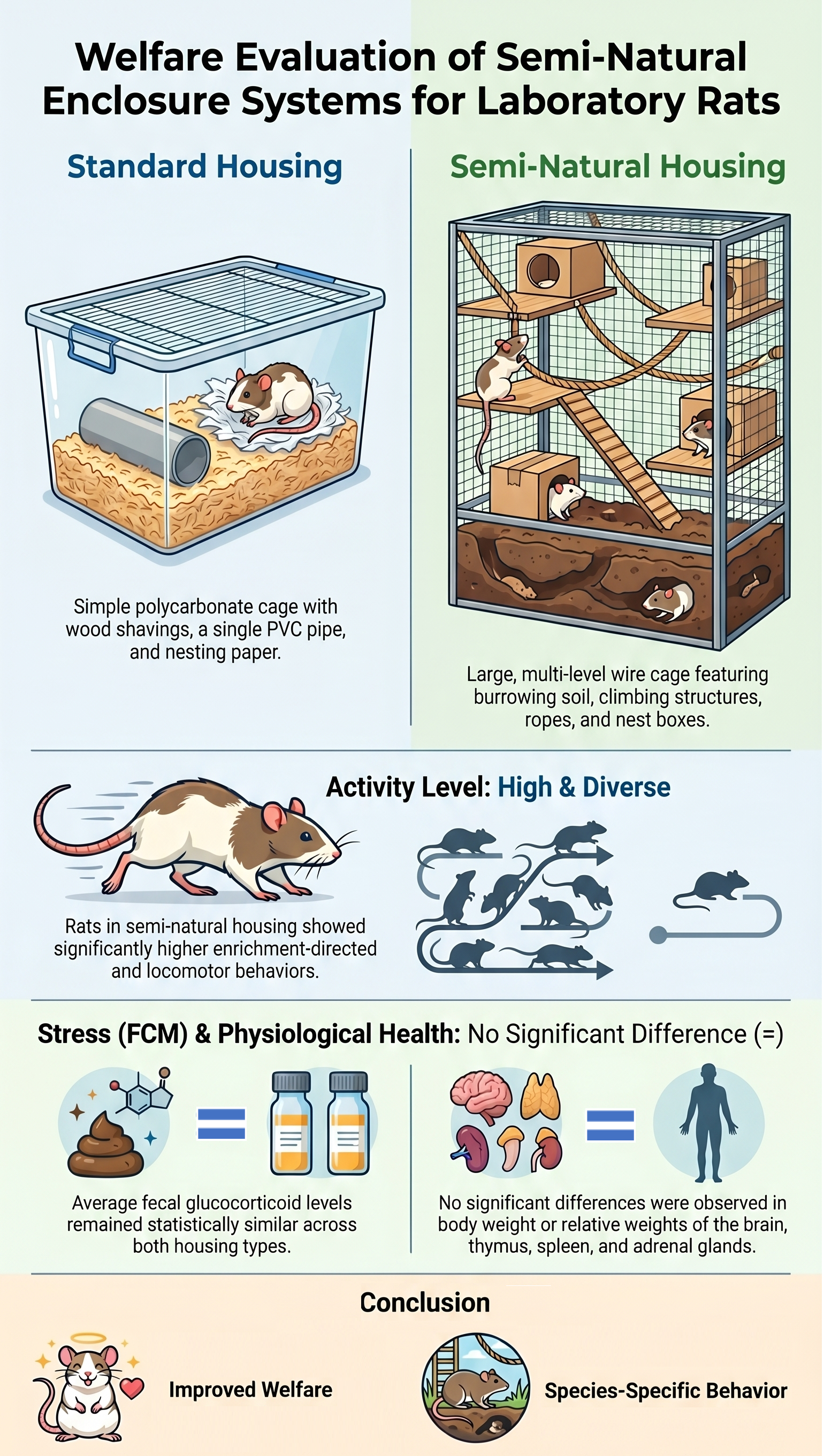
Introduction: Limited space often presents a significant challenge in laboratory animal housing systems, as it restricts the animals' capacity to exhibit species-specific behaviors due to enclosures and structural designs that differ from their natural habitats. The present study aimed to develop a complex caging system (semi-natural cages) equipped with different enrichment items to assess the welfare of rats housed in these cages by observing home-cage behaviors, measuring fecal glucocorticoid metabolites, body weight, and certain organ weights.
Materials and methods: Twenty-four, twelve-week-old female Sprague-Dawley rats with a mean weight of 239 ± 19 grams were randomly allocated to three semi-natural and three standard cages (four rats in each cage) and studied weekly for six weeks. Behavioral data were collected from four rats housed in each of the two cage types for five weeks via data-stamped video footage, which was randomly scored using scanning and focal analyses. Fecal glucocorticoid metabolite (FCM) concentrations were measured for six weeks using the Invitrogen progesterone competitive ELISA Kit, adapted for measuring 5a-pregnan-3b,11b,21-triol-20-one competitive enzyme immunoassay. Rats were weighed weekly, and the weights of the brain, thymus, spleen, and adrenal glands were measured at the end of the study.
Results: Rats in semi-natural enriched cages were more active than in standard cages. Significantly higher counts of enrichment-directed (U = 617) and non-intake (U = 1,908.5) behaviors were recorded in semi-natural cages compared to the standard cages. The counts of social interaction behaviors were significantly higher in standard cages (U = 2,255) than in semi-natural cages. No significant differences in body weight and organ weights were observed among the rats in the two cage types. Average FCM concentrations indicated periodic fluctuations and an overall upward trend over time in both housing systems. There was no significant difference between the mean FCM concentrations of rats housed in the two cage types.
Conclusion: The current findings supported the use of a semi-natural cage-housing system in rats.
Article Details

This work is licensed under a Creative Commons Attribution 4.0 International License.
All claims expressed in this article are solely those of the authors and do not necessarily represent those of their affiliated organizations, or those of the publisher, the editors, and the reviewers. Any product that may be evaluated in this article, or claim that may be made by its manufacturer, is not guaranteed or endorsed by the publisher.
References
Makowska IJ, and Weary DM. Differences in anticipatory behaviour between Rats (Rattus norvegicus) housed in standard versus semi-naturalistic laboratory Environments César Rincón tocado por hepatitis C. PLoS ONE. 2016; 11(1): e0147595. DOI: 10.1371/journal.pone.0147595
Sherwin CM. The influences of standard laboratory cages on rodents and the validity of research data. Anim Welf. 2004; 13(S1): S9-S15. DOI: 10.1017/S0962728600014329
Weary DM, and Robbins JA. Understanding the multiple conceptions of animal welfare. Anim Welf. 2019; 28(1): 33-40. DOI: 10.7120/09627286.28.1.033
Makowska IJ, and Weary DM. A Good life for laboratory rodents?. Institute Lab Anim Res. 2019; 60(3): 373-388. DOI: 10.1093/ilar/ilaa001
Huerkamp MJ, Mallon D, and Percifield G. Facility design, planning, and renovation. In: Weichbrod RH, Thompson GA, and Norton JN, editors. Management of animal care and use programs in research, education, and testing. 2nd ed. Boca Raton: CRC Press; 2018. p. 297-332.
Fox JG, Anderson LC, Otto GM, Pritchett-Corning KR, Whary MT, and American college of laboratory animal medicine. Laboratory animal medicine. 3rd ed. Amsterdam: Elsevier/Academic Press; 2015. p. 151-165.
Makowska IJ, Weary DM. The importance of burrowing, climbing and standing upright for laboratory rats. R Soc Open Sci. 2016; 3(6): 160136. DOI: 10.1098/rsos.160136
Hurst JL, Barnard CJ, Hare R, Wheeldon EB, and West CD. Housing and welfare in laboratory rats: Time-budgeting and pathophysiology in single-sex groups. Anim Behav. 1996; 52(2): 335-360. DOI: 10.1006/anbe.1996.0179
Olsson IAS, and Dahlborn K. Improving housing conditions for laboratory mice: A review of environmental enrichment. Lab Anim. 2002; 36(3): 243-270. DOI: 10.1258/002367702320162379
Makowska IJ, Franks B, El-Hinn C, Jorgensen T, and Weary DM. Standard laboratory housing for mice restricts their ability to segregate space into clean and dirty areas. Sci Rep. 2019; 9(1): 6179. DOI: 10.1038/s41598-019-42512-3
Achterberg EJM, Lozeman-van‘t Klooster JG, Pimentel TC, Aleksić A, Hendriks JCMJ, et al. Effect of social play deprivation on stress sensitivity in response to social and non-social challenges. Front Ethol. 2024; 3: 1458136. DOI: 10.3389/fetho.2024.1458136
Neville V, Mounty J, Benato L, Hunter K, Mendl M, and Paul ES. Thinking outside the lab: Can studies of pet rats inform pet and laboratory rat welfare? Appl Anim Behav Sci. 2022; 246: 105507. DOI: 10.1016/j.applanim.2021.105507
Beausoleil NJ, and Mellor DJ. Advantages and limitations of the Five Domains model for assessing welfare impacts associated with vertebrate pest control. N Z Vet J. 2015; 63(1): 37-43. DOI: 10.1080/00480169.2014.956832
Abou-Ismail UA, Burman OHP, Nicol CJ, and Mendl M. Let sleeping rats lie: Does the timing of husbandry procedures affect laboratory rat behaviour, physiology and welfare? Appl Anim Behav Sci. 2008; 111(3-4): 329-341. DOI: 10.1016/j.applanim.2007.06.019
Spangenberg EMF, Augustsson H, Dahlborn K, Essén-Gustavsson B, and Cvek K. Housing-related activity in rats: Effects on body weight, urinary corticosterone levels, muscle properties and performance. Lab Anim. 2005; 39(1): 45-57. DOI: 10.1258/0023677052886457
Rowland NE, and Toth LA. Analytic and interpretational pitfalls to measuring fecal corticosterone metabolites in laboratory rats and micetle. Comp Med. 2019; 69(5): 337-349. DOI: 10.30802/AALAS-CM-18-000119
Sheriff MJ, Krebs CJ, and Boonstra R. Assessing stress in animal populations: Do fecal and plasma glucocorticoids tell the same story? Gen Comp Endocrinol. 2010; 166(3): 614-619. DOI: 10.1016/j.ygcen.2009.12.017
Konkle ATM, Kentner AC, Baker SL, Stewart A, and Bielajew C. Environmental-enrichment-related variations in behavioral, biochemical, and physiologic responses of Sprague-Dawley and Long Evans rats. J Am Assoc Lab Anim Sci. 2010; 49(4): 427-436. Available at: https://pmc.ncbi.nlm.nih.gov/articles/PMC2919182/
Marashi V, Barnekow A, Ossendorf E, and Sachser N. Effects of different forms of environmental enrichment on behavioral, endocrinological, and immunological parameters in male mice. Hormones Behav. 2003; 43(2): 281-292. DOI: 10.1016/S0018-506X(03)00002-3
Reber SO, Birkeneder L, Veenema AH, Obermeier F, Falk W, Straub RH, et al. Adrenal insufficiency and colonic inflammation after a novel chronic psycho-social stress paradigm in mice: Implications and mechanisms. Endocrinol. 2007; 148(2): 670-682. DOI: 10.1210/en.2006-0983
Abou-Ismail UA, and Mahboub HD. The effects of enriching laboratory cages using various physical structures on multiple measures of welfare in singly-housed rats. Labo Anim. 2011; 45(3): 145-153. DOI: 10.1258/la.2011.010149
Faul F, Erdfelder E, Buchner A, and Lang AG. Statistical power analyses using G*Power 3.1: Tests for correlation and regression analyses. Behav Res Methods. 2009; 41(4): 1149-1160. DOI: 10.3758/BRM.41.4.1149
National research council of the national academies. Guide for the care and use of laboratory animals. 8th ed. Washington, DC: The National Academies Press; 2011. Available at: https://grants.nih.gov/grants/olaw/guide-for-the-care-and-use-of-laboratory-animals.pdf
Martin P, and Bateson P. Measuring behaviour: An Introductory guide. 3rd ed. Cambridge University Press, 2007. DOI: 10.1017/CBO9780511810893
Parker A, Romano S, Ansorge R, Aboelnour A, Le Gall G, Savva GM, et al. Fecal microbiota transfer between young and aged mice reverses hallmarks of the aging gut, eye, and brain. Microbiome. 2022; 10(1): 68. DOI: 10.1186/s40168-022-01243-w
Touma C, Sachser N, Möstl E, and Palme R. Effects of sex and time of day on metabolism and excretion of corticosterone in urine and feces of mice. Gen Comp Endocrinol. 2003; 130(3): 267-278. DOI: 10.1016/S0016-6480(02)00620-2
American veterinary medical association (AVMA). AVMA guidelines for the euthanasia of animals: 2020 edition. American Veterinary Medical Association, 2020. p. 60. Available at: https://www.avma.org/sites/default/files/2020-02/Guidelines-on-Euthanasia-2020.pdf
Neville V, Hunter K, Benato L, Mendl M, and Paul ES. Developing guidelines for pet rat housing through expert consultation. Vet Rec. 2023; 192(3): e1839. DOI: 10.1002/vetr.1839
Domínguez-Oliva A, Hernández-Avalos I, Bueno-Nava A, Chávez C, Verduzco-Mendoza A, Olmos-Hernández A, et al. Environmental enrichment for laboratory rats and mice: Endocrine, physiological, and behavioral benefits of meeting rodents' biological needs. Front Vet Sci. 2025; 12: 1622417. DOI: 10.3389/fvets.2025.1622417
Bayne K. Potential for unintended consequences of environmental enrichment for laboratory animals and research results. Ilar J. 2005; 46(2): 129-139. DOI: 10.1093/ilar.46.2.129
Lin EJD, Choi E, Liu X, Martin A, and During MJ. Environmental enrichment exerts sex-specific effects on emotionality in C57BL/6J mice. Behav Brain Res. 2011; 216(1): 349-357. DOI: 10.1016/j.bbr.2010.08.019
Mieske P, Hobbiesiefken U, Fischer-Tenhagen C, Heinl C, Hohlbaum K, Kahnau P, et al. Bored at home?-A systematic review on the effect of environmental enrichment on the welfare of laboratory rats and mice. Front Vet Sci. 2022; 9: 899219. DOI: 10.3389/fvets.2022.899219
Bailoo JD, Murphy E, Boada-Saña M, Varholick JA, Hintze S, Baussière C, et al. Effects of cage enrichment on behavior, welfare and outcome variability in female mice. Front Behav Neurosci. 2018; 12: 232. DOI: 10.3389/fnbeh.2018.00232
Ratuski AS, and Weary DM. Environmental Enrichment for Rats and Mice Housed in Laboratories: A Metareview. Animals. 2022; 12(4): 414. DOI: 10.3390/ani12040414
Hendershott TR, Cronin ME, Langella S, McGuinness PS, and Basu AC. Effects of environmental enrichment on anxiety-like behavior, sociability, sensory gating, and spatial learning in male and female C57BL/6J mice. Behav Brain Res. 2016; 314: 215-225. DOI: 10.1016/j.bbr.2016.08.004
Simpson J, and Kelly JP. The impact of environmental enrichment in laboratory rats - Behavioural and neurochemical aspects. Behav Brain Res. 2011; 222(1): 246-264. DOI: 10.1016/j.bbr.2011.04.002
Zheng L, Wang Y, Xiao Z, Rao Z, and Shi R. α-Klotho supplementation mitigates cumulative exercise-induced fatigue via coordinated NRF2-mediated antioxidant defense and AKT/GS-driven hepatic glycogen supercompensation in Mice. Int J Mol Sci. 2026; 27(1): 412. DOI: 10.3390/ijms27010412
Sun Y, An P, Cai Y, Yang W, Fang Y, Liu H, et al. Environmental enrichment reverses noise induced impairments in learning and memory associated with the hippocampus in female rats. Sci Rep. 2025; 15: 11509. DOI: 10.1038/s41598-025-96119-y
Abou-Ismail UA. The effects of cage enrichment on agonistic behaviour and dominance in male laboratory rats (Rattus norvegicus). Res Vet Sci. 2011; 90(2): 346-351. DOI: 10.1016/j.rvsc.2010.06.010
Hankenson FC, Marx JO, Gordon CJ, and David JM. Effects of rodent thermoregulation on animal models in the research environment. Comp Med. 2018; 68(6): 425-438. DOI: 10.30802/AALAS-CM-18-000049
Patterson-Kane EG, Harper DN, and Hunt M. The cage preferences of laboratory rats. Lab Anim. 2001; 35(1): 74-79. DOI: 10.1258/0023677011911390
Balcombe JP. Laboratory environments and rodents' behavioural needs: A review. Lab Anim. 2006; 40(3): 217-235. DOI: 10.1258/002367706777611488
Tsai PP, Stelzer HD, Hedrich HJ, and Hackbarth H. Are the effects of different enrichment designs on the physiology and behaviour of DBA/2 mice consistent? Lab Anim. 2003; 37(3): 314-327. DOI: 10.1258/002367703322389889
Eriksson E, Royo F, Lyberg K, Carlsson HE, and Hau J. Effect of metabolic cage housing on immunoglobulin A and corticosterone excretion in faeces and urine of young male rats. Exp Physiol. 2004; 89(4): 427-433. DOI: 10.1113/expphysiol.2004.027656
Dahlin J, Lam J, Hau J, Astuti P, Siswanto H, and Abelson KSP. Body weight and faecal corticosterone metabolite excretion in male Sprague-Dawley rats following short transportation and transfer from group-housing to single-housing. Scand J Lab Anim Sci. 2009; 36(2): 205-213. DOI: 10.23675/sjlas.v36i2.186