
Evaluation of ATG-5 and ATG-7 Gene Expression in the Autophagy Pathway by a Synthetic Circular MicroRNA Sponge Targeting miR-17 and miR-181 in the NALM-6 Cell Line
Article Sidebar
PDF downloads: 68
XML-Crossref downloads: 42
XML-DOAJ downloads: 49
Crossref Citations: 0

Main Article Content

Abstract
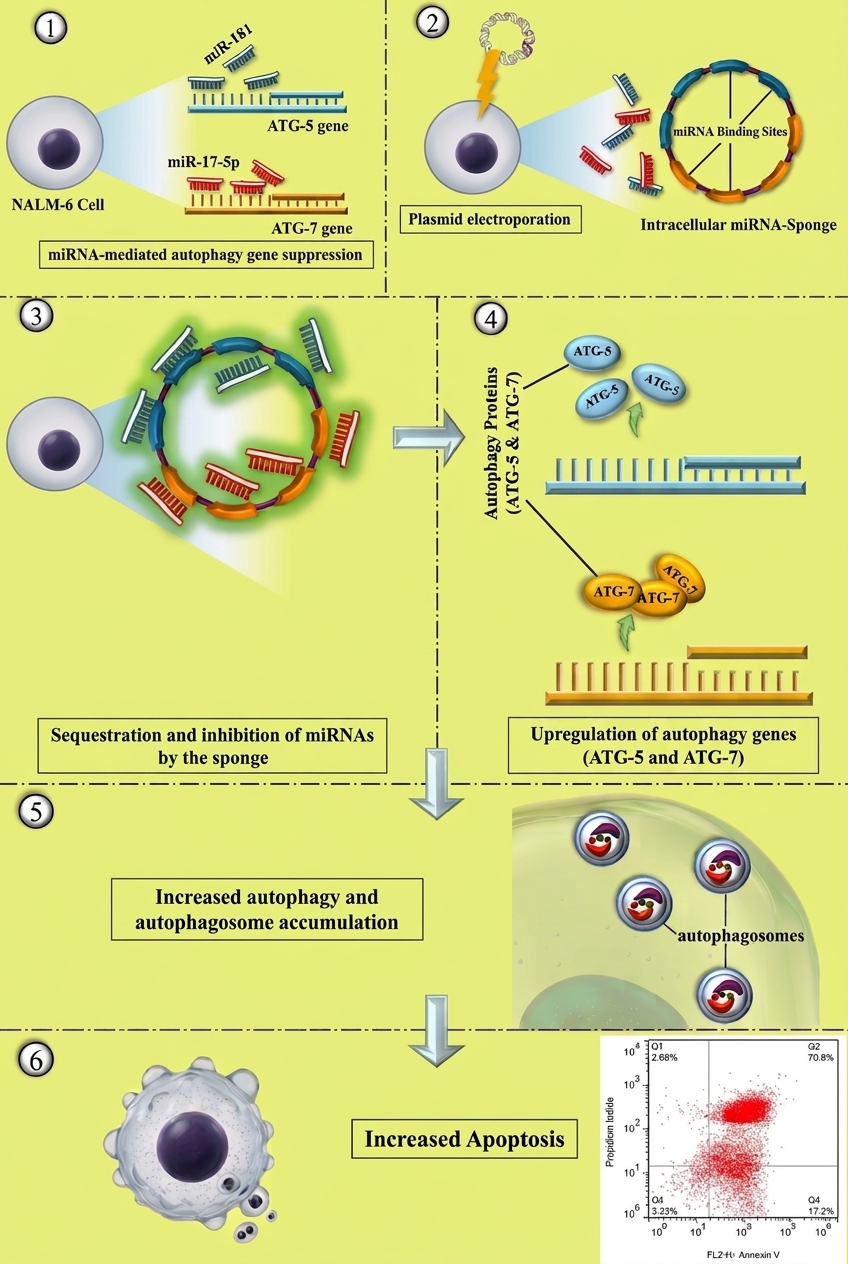
Introduction: MicroRNAs (miRNAs) can affect cellular processes by modulating the expression of different genes. Blocking specific miRNAs across all cancer types can reduce or prevent cancer cell activity. The present study aimed to investigate the inhibitory effects of MicroRNA sponges (miRSponge) on miR-17-5p and miR-181 in NALM-6 cells, a cellular model of acute lymphoblastic leukemia, and to evaluate their effects on the expression of the autophagy-related genes ATG-5 and ATG-7.
Materials and methods: The present study was conducted from 2021 to 2022 at Mashhad University of Medical Sciences, Iran, in collaboration with the Shiraz Paramedical Faculty, Iran, and focused on a miRSponge designed to target miR-17-5p and miR-181. The present study included four NALM-6 cell groups, including untreated cells as a control, miR-17-5p- and miR-181-sponge-transfected cells, and a vincristine-treated group. The NALM-6 cells were cultured and transfected with a miRSponge targeting miR-17-5p and miR-181. The expression levels of miR-17-5p, miR-181, ATG-5, and ATG-7 were quantified by real-time quantitative PCR, while apoptosis in cells from different study groups was assessed by flow cytometry using Annexin V/7-AAD staining. Cell viability following vincristine treatment was evaluated using MTT assay, and bioinformatics analyses were performed to investigate miRNA-target interactions.
Results: The current results indicated that the developed sponge significantly reduced the levels of these two oncogenic miRNAs in cells by binding to miR-17-5p and miR-181. Furthermore, the activity of ATG-5 and ATG-7, regulated by these two miRNAs, increased following the reduction in the expression of these miRNAs. Late-stage apoptosis was higher in miRSponge-treated cells than in vincristine-treated and control groups, although the difference was not statistically significant.
Conclusion: The present findings indicated that using a miRSponge significantly upregulated the ATG-5 and ATG-7 genes and enhanced autophagy and apoptosis in cancer cells. MicroRNA sponges reduced the effects of oncogenic miRNAs in acute lymphocytic leukemia cells.
Article Details

This work is licensed under a Creative Commons Attribution 4.0 International License.
All claims expressed in this article are solely those of the authors and do not necessarily represent those of their affiliated organizations, or those of the publisher, the editors, and the reviewers. Any product that may be evaluated in this article, or claim that may be made by its manufacturer, is not guaranteed or endorsed by the publisher.
References
Pui, CH, Campana D, and Evans WE. Childhood acute lymphoblastic leukaemia–current status and future perspectives. Lancet Oncol. 2001; 2(10): 597-607. DOI: 10.1016/S1470-2045(01)00516-2
Gökbuget N, and Hoelzer D. Meningeosis leukaemica in adult acute lymphoblastic leukaemia. J Neurooncol. 1998; 38: 167-180. DOI: 10.1023/A:1005963732481
Hu T, Chong Y, Qin H, Kitamura E, Chang CS, Silva J, et al. The miR-17/92 cluster is involved in the molecular etiology of the SCLL syndrome driven by the BCR-FGFR1 chimeric kinase. Oncogene. 2018; 37(14): 1926-1938. DOI: 10.1038/s41388-017-0091-1
Bartel DP. MicroRNAs: Genomics, biogenesis, mechanism, and function. Cell. 2004; 116(2): 281-297. DOI: 10.1016/S0092-8674(04)00045-5
Ambros V. The functions of animal microRNAs. Nature. 2004; 431(7006): 350-355. DOI: 10.1038/nature02871
Calin GA, Sevignani C, Dumitru CD, Hyslop T, Noch E, Yendamuri Y, et al. Human microRNA genes are frequently located at fragile sites and genomic regions involved in cancers. Proc Natl Acad Sci USA. 2004; 101(9): 2999-3004. DOI: 10.1073/pnas.0307323101
Wu W, Sun M, Zou GM, and Chen J. MicroRNA and cancer: Current status and prospective. Int J Cancer. 2007; 120(5): 953-960. DOI: 10.1002/ijc.22454
Zhao Y, Samal E, and Srivastava D. Serum response factor regulates a muscle-specific microRNA that targets Hand2 during cardiogenesis. Nature. 2005; 436(7048): 214-220. DOI: 10.1038/nature03817
Lu J, Getz G, Miska EA, Alvarez-Saavedra E, Lamb J, Peck D, et al. MicroRNA expression profiles classify human cancers. Nature. 2005; 435(7043): 834-838. DOI: 10.1038/nature03702
Mitchell PS, Parkin RK, Kroh EM, Fritz BR, Wyman SK, Pogosova-Agadjanyan EL, et al. Circulating microRNAs as stable blood-based markers for cancer detection. Proc Natl Acad Sci USA. 2008; 105(30): 10513-10518. DOI: 10.1073/pnas.0804549105
Mavrakis KJ, Wolfe AL, Oricchio E, Palomero T, de Keersmaecker K, McJunkin K, et al. Genome-wide RNA-mediated interference screen identifies miR-19 targets in Notch-induced T-cell acute lymphoblastic leukaemia. Nat Cell Biol. 2010; 12(4): 372-379. DOI: 10.1038/ncb2037
Ebert MS, Neilson JR, and Sharp PA. MicroRNA sponges: Competitive inhibitors of small RNAs in mammalian cells. Nat Methods. 2007; 4(9): 721-726. DOI: 10.1038/nmeth1079
Glickman MH, and Ciechanover A. The ubiquitin-proteasome proteolytic pathway: Destruction for the sake of construction. Physiol Rev. 2002; 82(2): 373-428. DOI: 10.1152/physrev.00027.2001
Mizushima N. The pleiotropic role of autophagy: From protein metabolism to bactericide. Cell Death Differ. 2005; 12(Suppl 2): 1535-1541. DOI: 10.1038/sj.cdd.4401728
Parzych KR, and Klionsky DJ. An overview of autophagy: Morphology, mechanism, and regulation. Antioxid Redox Signal. 2014; 20(3): 460-473. DOI: 10.1089/ars.2013.5371
Liu F, Lee JY, Wei H, Tanabe O, Engel JD, Morrison SJ, et al. FIP200 is required for the cell-autonomous maintenance of fetal hematopoietic stem cells. Blood. 2010; 116(23): 4806-4814. DOI: 10.1182/blood-2010-06-288589
Watson AS, Riffelmacher T, Stranks A, Williams O, De Boer J, Cain K, et al. Autophagy limits proliferation and glycolytic metabolism in acute myeloid leukemia. Cell Death Discov. 2015; 1: 15008. DOI: 10.1038/cddiscovery.2015.8
Giansanti V, Torriglia A, and Scovassi AI. Conversation between apoptosis and autophagy:“Is it your turn or mine?”. Apoptosis. 2011; 16(4): 321-333. DOI: 10.1007/s10495-011-0589-x
Levine B, and Kroemer G. Autophagy in the pathogenesis of disease. Cell. 2008; 132(1): 27-42. DOI: 10.1016/j.cell.2007.12.018
Chen N, and Debnath J. Autophagy and tumorigenesis. FEBS Lett. 2010; 584(7): 1427-1435. DOI: 10.1016/j.febslet.2009.12.034
Sun K, Deng W, Zhang S, Cai N, Jiao S, Song J, et al. Paradoxical roles of autophagy in different stages of tumorigenesis: Protector for normal or cancer cells. Cell Biosci. 2013; 3: 35. DOI: 10.1186/2045-3701-3-35
Brouns GS, de Vries E, Neefjes JJ, and Borst J. Assembled pre-B cell receptor complexes are retained in the endoplasmic reticulum by a mechanism that is not selective for the pseudo-light chain. J Biol Chem. 1996; 271(32): 19272-19278. DOI: 10.1074/jbc.271.32.19272
Wang J, Li D, Zhuang Y, Fu J, Li X, Shi Q, et al. Exosomes derived from bone marrow stromal cells decrease the sensitivity of leukemic cells to etoposide. Oncol Lett. 2017; 14(3): 3082-3088. DOI: 10.3892/ol.2017.6509
Benslimane Y, Sánchez‐Osuna M, Coulombe‐Huntington J, Bertomeu T, Henry D, Huard C, et al. A novel p53 regulator, C16ORF72/TAPR1, buffers against telomerase inhibition. Aging Cell. 2021; 20(4): e13331. DOI: 10.1111/acel.13331
Shafiee H, Fotouhi AR, Tandel P, Mortazavi F, Taheri S, Bahmei A, et al. Ganoderic acid extract induces apoptosis and upregulates autophagy-related genes in NALM-6 cell line: A potential therapeutic agent for acute lymphoblastic leukemia. Shiraz E-Med J. 2025; 26(5): 1-9. DOI: 10.5812/semj-143430
Chomczynski P, and Sacchi N. The single-step method of RNA isolation by acid guanidinium thiocyanate-phenol-chloroform extraction: Twenty-something years on. Nat Protoc. 2006; 1(2): 581-585. DOI: 10.1038/nprot.2006.83
Mortazavie F, Taheri S, Tandel P, Zare F, and Tamaddon G. The effect of Ganoderic Acid A on miR-17-5p and miR-181b expression level and apoptosis induction in human leukemia NALM-6 cells. Iran J Pediatr Hematol Oncol. 2022; 12(3): 152-163. DOI: 10.18502/ijpho.v12i3.10058
Barta T, Peskova L, and Hampl A. miRNAsong: A web-based tool for generation and testing of miRNA sponge constructs in silico. Sci Rep. 2016; 6(1): 36625. DOI: 10.1038/srep36625
Zhong T, Wang C, Hu J, Chen X, Niu L, Zhan S, et al. Comparison of MicroRNA transcriptomes reveals the association between MiR-148a-3p expression and rumen development in goats. Animals. 2020; 10(11): 1951. DOI: 10.3390/ani10111951
Chan WT, Verma CS, Lane DP, and Gan SKE. A comparison and optimization of methods and factors affecting the transformation of Escherichia coli. Biosci Rep. 2013; 33(6): e00086. DOI: 10.1042/BSR20130098
Rennie W, Liu C, Carmack CS, Wolenc A, Kanoria S, Lu J, et al. STarMir: A web server for prediction of microRNA binding sites. Nucleic Acids Res. 2014; 42(W1): W114-W118. DOI: 10.1093/nar/gku376
Diener C, Keller A, and Meese E. Emerging concepts of miRNA therapeutics: From cells to clinic. Trends Genet. 2022; 38(6): 613-626. DOI: 10.1016/j.tig.2022.02.006
Kluiver J, Gibcus JH, Hettinga C, Adema A, Richter MK, Halsema N, et al. Rapid generation of microRNA sponges for microRNA inhibition. PLoS One. 2012; 7(1): e29275. DOI: 10.1371/journal.pone.0029275
Jung J, Yeom C, Choi YS, Kim S, Lee E, Park MJ, et al. Simultaneous inhibition of multiple oncogenic miRNAs by a multi-potent microRNA sponge. Oncotarget. 2015; 6(24): 20370-20387. DOI: 10.18632/oncotarget.4827
Baraban JM, Shah A, and Fu X. Multiple pathways mediate MicroRNA degradation: focus on the Translin/Trax RNase complex. Adv Pharmacol. 2018; 82(1): 1-20. DOI: 10.1016/bs.apha.2017.08.003
Liang X, Yadav SP, Batz ZA, Nellissery J, and Swaroop A. Protein kinase CK2 modulates the activity of Maf-family bZIP transcription factor NRL in rod photoreceptors of mammalian retina. Hum Mol Genet. 2023; 32(6): 948-958. DOI: 10.1093/hmg/ddac256
Ji J, Yamashita T, Budhu A, Forgues M, Jia HL, Li C, et al. Identification of microRNA‐181 by genome‐wide screening as a critical player in EpCAM–positive hepatic cancer stem cells. Hepatol. 2009; 50(2): 472-480. DOI: 10.1002/hep.22989
Scherr M, Elder A, Battmer K, Barzan D, Bomken S, Ricke-Hoch M, et al. Differential expression of miR-17∼92 identifies BCL2 as a therapeutic target in BCR-ABL-positive B-lineage acute lymphoblastic leukemia. Leukemia. 2014; 28(3): 554-565. DOI: 10.1038/leu.2013.361
Piya S, Andreeff M, and Borthakur G. Targeting autophagy to overcome chemoresistance in acute myleogenous leukemia. Autophagy. 2017; 13(1): 214-215. DOI: 10.1080/15548627.2016.1245263
de Melo Maia B, Ling H, Monroig P, Ciccone M, Soares FA, Calin GA, et al. Design of a miRNA sponge for the miR-17 miRNA family as a therapeutic strategy against vulvar carcinoma. Mol Cell Probes. 2015; 29(6): 420-426. DOI: 10.1016/j.mcp.2015.08.002
Tekirdag KA, Korkmaz G, Ozturk DG, Agami R, and Gozuacik D. MIR181A regulates starvation-and rapamycin-induced autophagy through targeting of ATG5. Autophagy. 2013; 9(3): 374-385. DOI: 10.4161/auto.23117