
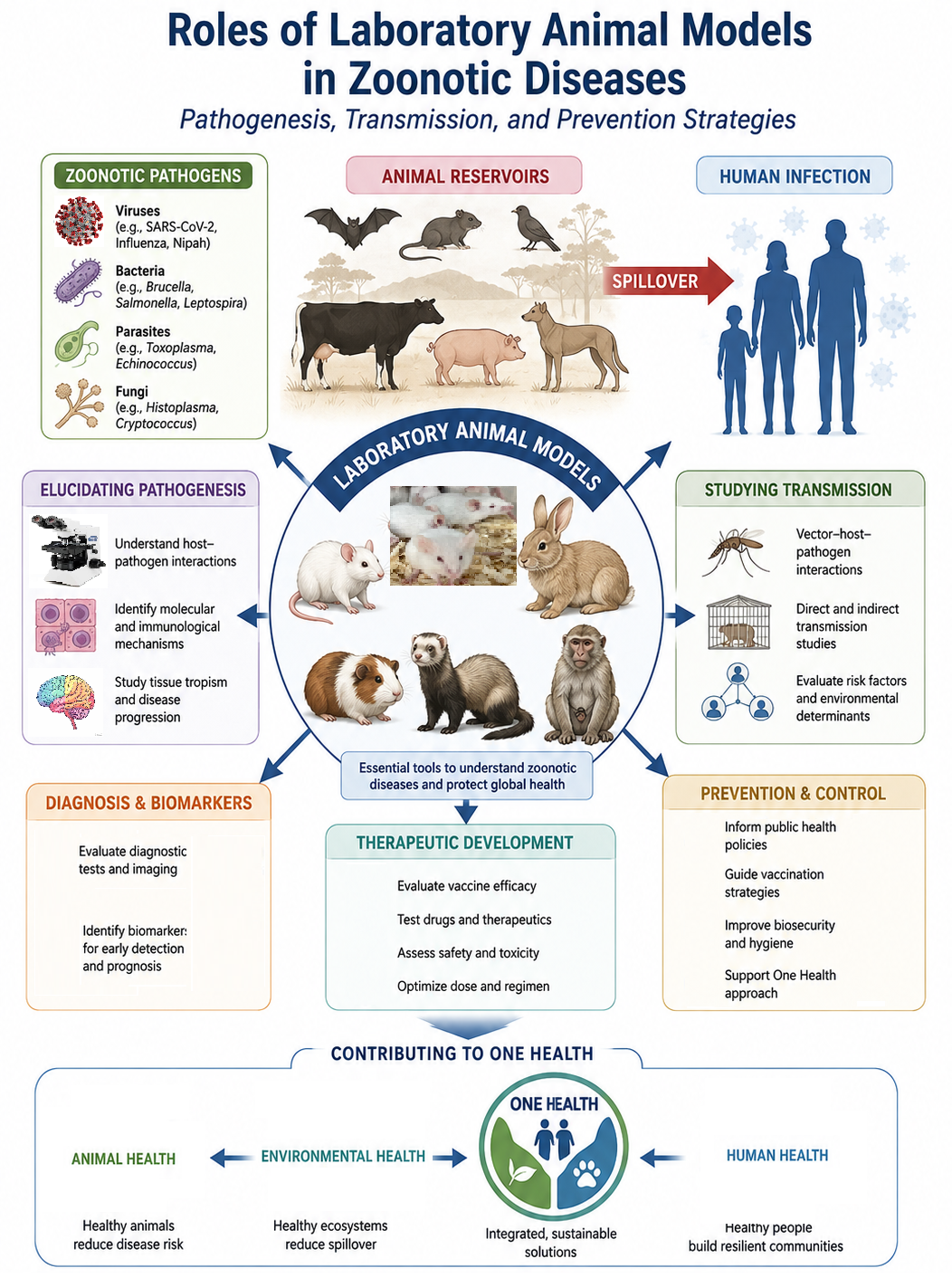
Roles of Laboratory Animal Models in Zoonotic Diseases: A Review on Pathogenesis, Transmission, and Prevention Strategies
Article Sidebar
PDF downloads: 138
XML-Crossref downloads: 46
XML-DOAJ downloads: 45
Crossref Citations: 0

Main Article Content

Abstract
Emerging zoonotic diseases have become an increasing concern for global health due to the rising incidence of pathogen transmission from animals to humans. The present study aimed to comprehensively synthesize the current knowledge on zoonotic disease outbreaks and transmission, with a specific focus on evaluating the role, applications, advantages, and limitations of laboratory animal models in this field. A peer-reviewed literature search was conducted in PubMed, Scopus, Web of Science, and Google Scholar for studies published between 2000 and 2026, supplemented by earlier pivotal studies. The current study evaluated a range of models, including conventional, humanized, and transgenic mice, hamsters, ferrets, guinea pigs, rabbits, non-human primates, and emerging alternatives, focusing on their utility, strengths, and drawbacks for studying host-pathogen interactions, immune responses, tissue tropism, and disease progression. The present study underscored the importance of animal models in the preclinical assessment of antiviral agents, vaccines, monoclonal antibodies, and innovative therapeutic strategies. Recent outbreaks caused by pathogens such as SARS-CoV-2, Nipah virus, H5N1 influenza virus, Mpox virus, Ebola virus, Marburg virus, hantavirus, and Crimean-Congo hemorrhagic fever virus have highlighted the urgent necessity to enhance comprehension of zoonotic disease emergence and transmission. The current challenges included species-specific differences, translational limitations, reproducibility, and ethical considerations, as well as emerging alternatives such as organoids, organ-on-chip platforms, and computational modeling, all of which were addressed in the present findings. Integrating advanced animal models with One Health approaches can strengthen disease surveillance and accelerate therapeutic development.
Article Details

This work is licensed under a Creative Commons Attribution 4.0 International License.
All claims expressed in this article are solely those of the authors and do not necessarily represent those of their affiliated organizations, or those of the publisher, the editors, and the reviewers. Any product that may be evaluated in this article, or claim that may be made by its manufacturer, is not guaranteed or endorsed by the publisher.
References
Rahman MT, Sobur MA, Islam MS, Ievy S, Hossain MJ, El Zowalaty ME, et al. Zoonotic diseases: Etiology, impact, and control. Microorganisms. 2020; 8(9): 1405. DOI: 10.3390/microorganisms8091405
Lombardi AF, Afsahi AM, Gupta A, and Gholamrezanezhad A. Severe acute respiratory syndrome (SARS), Middle East respiratory syndrome (MERS), influenza, and COVID-19, beyond the lungs: A review article. Radiol Med. 2021; 126(4): 561-569. DOI: 10.1007/s11547-020-01311-x
Bhatia B, Sonar S, Khan S, and Bhattacharya J. Pandemic-proofing: Intercepting zoonotic spillover events. Pathogens. 2024; 13(12): 1067. DOI: 10.3390/pathogens13121067
Wilcox BA, and Gubler DJ. Disease ecology and the global emergence of zoonotic pathogens. Environ Health Prev Med. 2005; 10(5): 263-272. DOI: 10.1265/ehpm.10.263
Hassell JM, Begon M, Ward MJ, and Fèvre EM. Urbanization and disease emergence: dynamics at the wildlife-livestock-human interface. Trends Ecol Evol. 2017; 32(1): 55-67. DOI: 10.1016/j.tree.2016.09.012
Travis DA, Watson RP, and Tauer A. The spread of pathogens through trade in wildlife. Sci Tech Rev. 2011; 30(1): 219-231. DOI: 10.20506/rst.30.1.2035
Esposito MM, Turku S, Lehrfield L, and Shoman A. The impact of human activities on zoonotic infection transmissions. Animals. 2023; 13(10): 1646. DOI: 10.3390/ani13101646
Kane Y, Wong G, and Gao GF. Animal models, zoonotic reservoirs, and cross-species transmission of emerging human-infecting coronaviruses. Annu Rev Anim Biosci. 2023; 11(1): 1-31. DOI: 10.1146/annurev-animal-020420-025011
Pradhan B, and Satapathy T. Experimental animal models of human depression: Understanding the mechanism of anti-depressant agents. J Lab Anim Res. 2024; 3(2): 6-16. DOI: 10.58803/jlar.v3i2.40
Farah IO, Ngotho M, Kariuki T, Jeneby N, Maina N, Kagira JM, et al. Animal models of tropical parasitic diseases. Handbook of laboratory animal science. 3rd ed. Florida: CRC Press; 2004. p. 169-223. Available at: https://www.cabidigitallibrary.org/doi/abs/10.5555/20053033054
Plowright RK, Parrish CR, McCallum H, Hudson PJ, Ko AI, Graham AL, et al. Pathways to zoonotic spillover. Nat Rev Microbiol. 2017; 15(8): 502-510. DOI: 10.1038/nrmicro.2017.45
World health organization (WHO). Zoonoses. WHO, 2020. Available at: https://www.who.int/news-room/fact-sheets/detail/zoonoses
Karesh WB, Dobson A, Lloyd-Smith JO, Lubroth J, Dixon MA, Bennett M, et al. Ecology of zoonoses: Natural and unnatural histories. Lancet. 2012; 380(9857): 1936-1945. DOI: 10.1016/S0140-6736(12)61678-X
Jones KE, Patel NG, Levy MA, Storeygard A, Balk D, Gittleman JL, et al. Global trends in emerging infectious diseases. Nature. 2008; 451(7181): 990-993. DOI: 10.1038/nature06536
Letko M, Seifert SN, Olival KJ, Plowright RK, and Munster VJ. Bat-borne virus diversity, spillover and emergence. Nat Rev Microbiol. 2020; 18(8): 461-471. DOI: 10.1038/s41579-020-0394-z
Letko M, Plowright RK, and Munster VJ. Ecology, evolution and spillover of coronaviruses from bats. Nat Rev Microbiol. 2022; 20(5): 299-314. DOI: 10.1038/s41579-021-00652-2
Hakimi H, Sarani A, Takeda M, Kaneko O, and Asada M. Epidemiology, risk factors, and co-infection of vector-borne pathogens in goats from Sistan and Baluchestan province, Iran. PLoS One. 2019; 14(6): e0218609. DOI: 10.1371/journal.pone.0218609
Cantas L, and Suer K. The important bacterial zoonoses in "One Health" concept. Front Public Health. 2014; 2: 144. DOI: 10.3389/fpubh.2014.00144
Shahrokhi A, Moradpour N, Siahsarvie R, and Borji H. An investigation of potentially zoonotic helminth parasites of Allactaga elater in Sarakhs, Iran. J Lab Anim Res. 2022; 1(1): 8-13. DOI: 10.58803/jlar.v1i1.7
Jahantigh FF, Rasekh M, Ganjali M, and Sarani A. Seroprevalence of Toxoplasma gondii infection among pregnant women and small ruminant populations in Sistan region, Iran. Iran J Vet Med. 2020; 14(3): 215-224. DOI: 10.22059/ijvm.2020.294216.1005048
Kaminsky R, and Mäser P. Global impact of parasitic infections and the importance of parasite control. Front Parasitol. 2025; 4: 1546195. DOI: 10.3389/fpara.2025.1546195
Friedman DZ, and Schwartz IS. Emerging fungal infections: New patients, new patterns, and new pathogens. J Fungi. 2019; 5(3): 67. DOI: 10.3390/jof5030067
Carpouron JE, de Hoog S, Gentekaki E, and Hyde KD. Emerging animal-associated fungal diseases. J Fungi. 2022; 8(6): 611. DOI: 10.3390/jof8060611
Hon CC, Lam TY, Shi ZL, Drummond AJ, Yip CW, Zeng F, et al. Evidence of the recombinant origin of a bat severe acute respiratory syndrome (SARS)-like coronavirus and its implications on the direct ancestor of SARS coronavirus. J Virol. 2008; 82(4): 1819-1826. DOI: 10.1128/jvi.01926-07
Singh RK, Dhama K, Chakraborty S, Tiwari R, Natesan S, Khandia R, et al. Nipah virus: Epidemiology, pathology, immunobiology and advances in diagnosis, vaccine designing and control strategies – a comprehensive review. Vet Q. 2019; 39(1): 26-55. DOI: 10.1080/01652176.2019.1580827
Bruno L, Nappo MA, Ferrari L, Di Lecce R, Guarnieri C, Cantoni AM, et al. Nipah virus disease: Epidemiological, clinical, diagnostic and legislative aspects of this unpredictable emerging zoonosis. Animals. 2022; 13(1): 159. DOI: 10.3390/ani13010159
Nuñez IA, and Ross TM. A review of H5Nx avian influenza viruses. Ther Adv Vaccines Immunother. 2019; 7: 2515135518821625. DOI: 10.1177/2515135518821625
Van Kerkhove MD, Mumford E, Mounts AW, Bresee J, Ly S, Bridges CB, et al. Highly pathogenic avian influenza (H5N1): Pathways of exposure at the animal–human interface, a systematic review. PLoS One. 2011; 6(1): e14582. DOI: 10.1371/journal.pone.0014582
Falendysz EA, Lopera JG, Rocke TE, and Osorio JE. Monkeypox virus in animals: Current knowledge of viral transmission and pathogenesis in wild animal reservoirs and captive animal models. Viruses. 2023; 15(4): 905. DOI: 10.3390/v15040905
Srivastava S, Kumar S, Jain S, Mohanty A, Thapa N, Poudel P, et al. The global monkeypox (Mpox) outbreak: a comprehensive review. Vaccines. 2023; 11(6): 1093. DOI: 10.3390/vaccines11061093
Chen RX, Gong HY, Wang X, Sun MH, Ji YF, Tan SM, et al. Zoonotic Hantaviridae with global public health significance. Viruses. 2023; 15(8): 1705. DOI: 10.3390/v15081705
Nicastri E, Kobinger G, Vairo F, Montaldo C, Mboera LE, Ansunama R, et al. Ebola virus disease: Epidemiology, clinical features, management, and prevention. Infect Dis Clin. 2019; 33(4): 953-976. DOI: 10.1016/j.idc.2019.08.005
Woolsey C, and Geisbert TW. Marburg virus disease: A comprehensive review. Clin Microbiol Rev. 2026; e00097-23. DOI: 10.1128/cmr.00097-23
Shahhosseini N, Wong G, Babuadze G, Camp JV, Ergonul O, Kobinger GP, et al. Crimean-Congo hemorrhagic fever virus in Asia, Africa and Europe. Microorganisms. 2021; 9(9): 1907. DOI: 10.3390/microorganisms9091907
Hoogstraal H. The epidemiology of tick-borne Crimean-Congo hemorrhagic fever in Asia, Europe, and Africa. J Med Entomol. 1979; 15(4): 307-417. DOI: 10.1093/jmedent/15.4.307
Escudero-Pérez B, Lalande A, Mathieu C, and Lawrence P. Host–pathogen interactions influencing zoonotic spillover potential and transmission in humans. Viruses. 2023; 15(3): 599. DOI: 10.3390/v15030599
Begeman L, Van Riel D, Koopmans MP, and Kuiken T. The pathogenesis of zoonotic viral infections: Lessons learned by studying reservoir hosts. Front Microbiol. 2023; 14: 1151524. DOI: 10.3389/fmicb.2023.1151524
Singh BB, Ward MP, and Dhand NK. Host characteristics and their influence on zoonosis, disease emergence and multi-host pathogenicity. One Health. 2023; 17: 100596. DOI: 10.1016/j.onehlt.2023.100596
Ou J, Zhou Z, Dai R, Zhang J, Zhao S, Wu X, et al. V367F mutation in SARS-CoV-2 spike RBD emerging during the early transmission phase enhances viral infectivity through increased human ACE2 receptor binding affinity. J Virol. 2021; 95(16): e00617-21. DOI: 10.1128/JVI.00617-21
Thakur A, Mikkelsen H, and Jungersen G. Intracellular pathogens: Host immunity and microbial persistence strategies. J Immunol Res. 2019; 2019(1): 1356540. DOI: 10.1155/2019/1356540
Pizarro-Cerdá J, and Cossart P. Bacterial adhesion and entry into host cells. Cell. 2006; 124(4): 715-727. DOI: 10.1016/j.cell.2006.02.012
Kwok AJ, Mentzer A, and Knight JC. Host genetics and infectious disease: New tools, insights and translational opportunities. Nat Rev Genet. 2021; 22(3): 137-153. DOI: 10.1038/s41576-020-00297-6
Plowright RK, Ahmed AN, Coulson T, Crowther TW, Ejotre I, Faust CL, et al. Ecological countermeasures to prevent pathogen spillover and subsequent pandemics. Nat Commun. 2024; 15(1): 2577. DOI: 10.1038/s41467-024-46151-9
Dolan PT, Whitfield ZJ, and Andino R. Mechanisms and concepts in RNA virus population dynamics and evolution. Annu Rev Virol. 2018; 5(1): 69-92. DOI: 10.1146/annurev-virology-101416-041718
Chen Y, Wu X, Xu C, Huang J, Zhang L, Qiu P, et al. Pathogen virulence genes: advances, challenges and future directions in infectious disease research. Int J Mol Med. 2025; 56(5): 173. DOI: 10.3892/ijmm.2025.5614
Purushotham JN, Lutz HL, Parker E, and Andersen KG. Immunological drivers of zoonotic virus emergence, evolution, and endemicity. Immunity. 2025; 58(4): 784-796. DOI: 10.1016/j.immuni.2025.03.014
Mabbott NA. The influence of parasite infections on host immunity to co-infection with other pathogens. Front Immunol. 2018; 9: 2579. DOI: 10.3389/fimmu.2018.02579
Casadevall A, and Pirofski LA. Virulence factors and their mechanisms of action: The view from a damage–response framework. J Water Health. 2009; 7(S1): S2-S18. DOI: 10.2166/wh.2009.036
Kitamoto S, Nagao-Kitamoto H, Kuffa P, and Kamada N. Regulation of virulence: the rise and fall of gastrointestinal pathogens. J Gastroenterol. 2016; 51(3): 195-205. DOI: 10.1007/s00535-015-1140-6
McCall LI, Siqueira-Neto JL, and McKerrow JH. Location, location, location: Five facts about tissue tropism and pathogenesis. PLoS Pathog. 2016; 12(5): e1005519. DOI: 10.1371/journal.ppat.1005519
Desforges M, Le Coupanec A, Dubeau P, Bourgouin A, Lajoie L, Dubé M, et al. Human coronaviruses and other respiratory viruses: Underestimated opportunistic pathogens of the central nervous system? Viruses. 2019; 12(1): 14. DOI: 10.3390/v12010014
Alexander KA, Carlson CJ, Lewis BL, Getz WM, Marathe MV, Eubank SG, et al. The ecology of pathogen spillover and disease emergence at the human-wildlife-environment interface. In: Hurst CJ, editor. The connections between ecology and infectious disease. Cham: Springer International Publishing; 2018. p. 267-298. DOI: 10.1007/978-3-319-92373-4_8
Greger M. The human/animal interface: Emergence and resurgence of zoonotic infectious diseases. Crit Rev Microbiol. 2007; 33(4): 243-299. DOI: 10.1080/10408410701647594
Parrish CR, Holmes EC, Morens DM, Park EC, Burke DS, Calisher CH, et al. Cross-species virus transmission and the emergence of new epidemic diseases. Microbiol Mol Biol Rev. 2008; 72(3): 457-470. DOI: 10.1128/MMBR.00004-08
Straif-Bourgeois S, Tonzel JL, Kretzschmar M, and Ratard R. Infectious disease epidemiology. In: Ahrens W, Pigeot I, editors. Handbook of epidemiology. 2nd ed. New York, NY: Springer New York; 2023. p. 1-79. DOI: 10.1007/978-1-4614-6625-3_34-1
Friedman R, and Perl TM. Outbreaks of emerging and re-emerging infections and their management in healthcare settings. Infect Dis Clin. 2026; 40(2): 317-342. DOI: 10.1016/j.idc.2026.02.001
Rees EM, Minter A, Edmunds WJ, Lau CL, Kucharski AJ, and Lowe R. Transmission modelling of environmentally persistent zoonotic diseases: A systematic review. Lancet Planet Health. 2021; 5(7): E466-E478. DOI: 10.1016/S2542-5196(21)00137-6
Turner WC, Kamath PL, Van Heerden H, Huang YH, Barandongo ZR, Bruce SA, et al. The roles of environmental variation and parasite survival in virulence–transmission relationships. R Soc Open Sci. 2021; 8(6): 210088. DOI: 10.1098/rsos.210088
Dobson A. Population dynamics of pathogens with multiple host species. Am Nat. 2004; 164(S5): S64-S78. DOI: 10.1086/424681
Calisher CH, Childs JE, Field HE, Holmes KV, and Schountz T. Bats: Important reservoir hosts of emerging viruses. Clin Microbiol Rev. 2006; 19(3): 531-545. DOI: 10.1128/CMR.00017-06
Dietrich M, Gómez-Díaz E, and McCoy KD. Worldwide distribution and diversity of seabird ticks: Implications for the ecology and epidemiology of tick-borne pathogens. Vector Borne Zoonotic Dis. 2011; 11(5): 453-470. DOI: 10.1089/vbz.2010.0009
Viana M, Mancy R, Biek R, Cleaveland S, Cross PC, Lloyd-Smith JO, et al. Assembling evidence for identifying reservoirs of infection. Trends Ecol Evol. 2014; 29(5): 270-279. DOI: 10.1016/j.tree.2014.03.002
Karesh WB, Dobson A, Lloyd-Smith JO, Lubroth J, Dixon MA, Bennett M, et al. Ecology of zoonoses: Natural and unnatural histories. Lancet. 2012; 380(9857): 1936-1945. DOI: 10.1016/S0140-6736(12)61678-X
Pearce-Duvet JM. The origin of human pathogens: Evaluating the role of agriculture and domestic animals in the evolution of human disease. Biol Rev. 2006; 81(3): 369-382. DOI: 10.1017/S1464793106007020
Gamble A, Olarte-Castillo XA, and Whittaker GR. Backyard zoonoses: The roles of companion animals and peri-domestic wildlife. Sci Transl Med. 2023; 15(718): eadj0037. DOI: 10.1126/scitranslmed.adj0037
Pauciullo S, Zulian V, La Frazia S, Paci P, and Garbuglia AR. Spillover: Mechanisms, genetic barriers, and the role of reservoirs in emerging pathogens. Microorganisms. 2024; 12(11): 2191. DOI: 10.3390/microorganisms12112191
Dominguez-Oliva A, Hernández-Ávalos I, Martinez-Burnes J, Olmos-Hernandez A, Verduzco-Mendoza A, and Mota-Rojas D. The importance of animal models in biomedical research: Current insights and applications. Animals. 2023; 13(7): 1223. DOI: 10.3390/ani13071223
Silva MJ, Fehrenbach GW, Pogue R, Murray P, Rezoagli E, Laffey JG, et al. Sepsis modelling: Current approaches and organ-on-chip perspectives. EBioMedicine. 2026; 125: 106120. DOI: 10.1016/j.ebiom.2026.106120
Sarkar S, and Heise MT. Mouse models as resources for studying infectious diseases. Clin Ther. 2019; 41(10): 1912-1922. DOI: 10.1016/j.clinthera.2019.08.010
Chuprin J, Buettner H, Seedhom MO, Greiner DL, Keck JG, Ishikawa F, et al. Humanized mouse models for immuno-oncology research. Nat Rev Clin Oncol. 2023; 20(3): 192-206. DOI: 10.1038/s41571-022-00721-2
Park JG, Pino PA, Akhter A, Alvarez X, Torrelles JB, and Martinez-Sobrido L. Animal models of COVID-19: Transgenic mouse model. In: Chu JJH, Ahidjo BA, Mok CK, editors. SARS-CoV-2: Methods and protocols. New York, NY: Springer USA; 2022. p. 259-289. DOI: 10.1007/978-1-0716-2111-0_16
Lutz C, Maher L, Lee C, and Kang W. COVID-19 preclinical models: Human angiotensin-converting enzyme 2 transgenic mice. Hum Genomics. 2020; 14(1): 20. DOI: 10.1186/s40246-020-00272-6
Miao J, Chard LS, Wang Z, and Wang Y. Syrian hamster as an animal model for the study on infectious diseases. Front Immunol. 2019; 10: 2329. DOI: 10.3389/fimmu.2019.02329
Iwatsuki-Horimoto K, Nakajima N, Ichiko Y, Sakai-Tagawa Y, Noda T, Hasegawa H, et al. Syrian hamster as an animal model for the study of human influenza virus infection. J Virol. 2018; 92(4): e01693-17. DOI: 10.1128/JVI.01693-17
Gruber AD, Firsching TC, Trimpert J, and Dietert K. Hamster models of COVID-19 pneumonia reviewed: How human can they be?. Vet Pathol. 2022; 59(4): 528-545. DOI: 10.1177/03009858211057197
Kane Y, Wong G, and Gao GF. Animal models, zoonotic reservoirs, and cross-species transmission of emerging human-infecting coronaviruses. Annu Rev Anim Biosci. 2023; 11(1): 1-31. DOI: 10.1146/annurev-animal-020420-025011
Pramod RK, Atul PK, Pandey M, Anbazhagan S, Mhaske ST, and Barathidasan R. Care, management, and use of ferrets in biomedical research. Lab Anim Res. 2024; 40(1): 10. DOI: 10.1186/s42826-024-00197-4
Smith RE, Choudhary S, and Ramirez JA. Ferrets as models for viral respiratory disease. Comp Med. 2023; 73(3): 187-193. DOI: 10.30802/AALAS-CM-22-000109
Buela L, Cuenca M, Sarmiento J, Peláez D, Mendoza AY, Cabrera EJ, et al. Role of guinea pigs (Cavia porcellus) raised as livestock in Ecuadorian Andes as reservoirs of zoonotic yeasts. Animals. 2022; 12(24): 3449. DOI: 10.3390/ani12243449
Hensel ME, and Arenas-Gamboa AM. A neglected animal model for a neglected disease: Guinea pigs and the search for an improved animal model for human brucellosis. Front Microbiol. 2018; 9: 2593. DOI: 10.3389/fmicb.2018.02593
Yadav SK, Tabassum M, Yadav S, and Ahaduzzaman M. Evaluation of injectable anaesthetic drugs during spaying in rabbits. J Lab Anim Res. 2025; 4(6): 63-66. DOI: 10.58803/jlar.v4i6.85
Esteves PJ, Abrantes J, Baldauf HM, BenMohamed L, Chen Y, Christensen N, et al. The wide utility of rabbits as models of human diseases. Exp Mol Med. 2018; 50(5): 1-10. DOI: 10.1038/s12276-018-0094-1
Moshaveri A, Babazadeh D, Modarresi-Ghazani F, Hejazi V, Saeed M, and Ahmadi Simab P. The effect of topical nitroglycerin on wound healing in rabbits using histopathological investigation. J Vet Physiol Pathol. 2022; 1(1): 10-16. DOI: 10.58803/jvpp.v1i1.7
Peng X, Knouse JA, and Hernon KM. Rabbit models for studying human infectious diseases. Comp Med. 2015; 65(6): 499-508. Available at: https://pubmed.ncbi.nlm.nih.gov/26678367/
Suckow MA, Stevens KA, and Wilson RP, editors. The laboratory rabbit, guinea pig, hamster, and other rodents. Academic Press, 2011. Available at: https://books.google.com/books/about/The_Laboratory_Rabbit_Guinea_Pig_Hamster.html?id=HhEs-xsYp6IC
Burgos-Rodriguez AG. Zoonotic diseases of primates. Vet Clin North Am Exot Anim Pract. 2011; 14(3): 557-575. DOI: 10.1016/j.cvex.2011.05.006
Kwon T. Utilizing non-human primate models to combat recent COVID-19/SARS-CoV-2 and viral infectious disease outbreaks. J Med Primatol. 2024; 53(1): e12689. DOI: 10.1111/jmp.12689
Vashishat A, Patel P, Das Gupta G, and Das Kurmi B. Alternatives of animal models for biomedical research: A comprehensive review of modern approaches. Stem Cell Rev Rep. 2024; 20(4): 881-899. DOI: 10.1007/s12015-024-10701-x
Steiner N, Brezzina T, Felmy F, Kiene F, Silberstein Y, Ciurkiewicz M, et al. Clinical pathology of renal amyloidosis in a captive population of tree shrews (Tupaia belangeri). J Lab Anim Res. 2026; 5(1): 1-14. DOI: 10.58803/jlar.v5i1.88
Wen X, Mo S, Chen S, Yu G, Gao L, Chen S, et al. Pathogenic difference of respiratory syncytial virus infection in cotton rats of different ages. Microb Pathog. 2019; 137: 103749. DOI: 10.1016/j.micpath.2019.103749
Brüssow H. From bat to worse: The pivotal role of bats for viral zoonosis. Microb Biotechnol. 2025; 18(7): e70190. DOI: 10.1111/1751-7915.70190
Siddiqui S, Siddiqui H, Riguene E, and Nomikos M. Zebrafish: A versatile and powerful model for biomedical research. BioEssays. 2025; 47(12): e70080. DOI: 10.1002/bies.70080
Morrison TE, and Diamond MS. Animal models of Zika virus infection, pathogenesis, and immunity. J Virol. 2017; 91(8): e00009-17. DOI: 10.1128/JVI.00009-17
Zhang B, Duan Z, and Zhao Y. Mouse models with human immunity and their application in biomedical research. J Cell Mol Med. 2009; 13(6): 1043-1058. DOI: 10.1111/j.1582-4934.2008.00347.x
Schäfer A, Leist SR, Powers JM, and Baric RS. Animal models of long COVID: A hit-and-run disease. Sci Transl Med. 2024; 16(773): eado2104. DOI: 10.1126/scitranslmed.ado2104
Vella R, Panci D, Carini F, Malta G, Vieni S, David S, et al. Cytokines in sepsis: A critical review of the literature on systemic inflammation and multiple organ dysfunction. Front Immunol. 2025; 16: 1682306. DOI: 10.3389/fimmu.2025.1682306
Nogueira A, Pires MJ, and Oliveira PA. Pathophysiological mechanisms of renal fibrosis: A review of animal models and therapeutic strategies. In Vivo. 2017; 31(1): 1-22. DOI: 10.21873/invivo.11019
Dominguez-Oliva A, Hernández-Ávalos I, Martinez-Burnes J, Olmos-Hernandez A, Verduzco-Mendoza A, and Mota-Rojas D. The importance of animal models in biomedical research: Current insights and applications. Animals. 2023; 13(7): 1223. DOI: 10.3390/ani13071223
Baric TJ, and Reneer ZB. Animal models, therapeutics, and vaccine approaches to emerging and re-emerging flaviviruses. Viruses. 2024; 17(1): 1. DOI: 10.3390/v17010001
Burton DR. Antiviral neutralizing antibodies: From in vitro to in vivo activity. Nat Rev Immunol. 2023; 23(11): 720-734. DOI: 10.1038/s41577-023-00858-w
Lotfalizadeh N, Sadr S, Ahmadi Simab P, Hajjafari A, Borji H, and Bayat Z. CRISPR/Cas9-mediated genome editing: In vivo review. J Lab Anim Res. 2022; 1(1): 47-51. DOI: 10.58803/jlar.v1i1.13
Erkyihun GA, and Alemayehu MB. One Health approach for the control of zoonotic diseases. Zoonoses. 2022; 2(1): 1-11. DOI: 10.15212/ZOONOSES-2022-0037
Singh S, Sharma P, Pal N, Sarma DK, Tiwari R, and Kumar M. Holistic One Health surveillance framework: Synergizing environmental, animal, and human determinants for enhanced infectious disease management. ACS Infect Dis. 2024; 10(3): 808-826. DOI: 10.1021/acsinfecdis.3c00625
Carpenter A, Waltenburg MA, Hall A, Kile J, Killerby M, Knust B, et al. Vaccine preventable zoonotic diseases: Challenges and opportunities for public health progress. Vaccines. 2022; 10(7): 993. DOI: 10.3390/vaccines10070993
Jimenez CE, Keestra S, Tandon P, Cumming O, Pickering AJ, Moodley A, et al. Biosecurity and water, sanitation, and hygiene (WASH) interventions in animal agricultural settings for reducing infection burden, antibiotic use, and antibiotic resistance: A One Health systematic review. Lancet Planet Health. 2023; 7(5): e418-e434. DOI: 10.1016/S2542-5196(23)00049-9