Efficacy, Safety, and Post-Operative Complications of Three Anesthetic Protocols for Ovariohysterectomy in Rabbits
Article Sidebar
PDF downloads: 193
XML-Crossref downloads: 52
XML-DOAJ downloads: 52
Crossref Citations: 0

Main Article Content

Abstract
Introduction: Rabbits are sensitive to anesthesia and prone to perioperative complications, such as cardiorespiratory depression and hypothermia. Choosing a safe, effective anesthetic protocol is essential for surgeries such as ovariohysterectomy. The present study aimed to evaluate and compare the efficacy and safety of three anesthetic protocols, including ketamine, xylazine-ketamine, and diazepam-ketamine, in rabbits undergoing ovariohysterectomy.
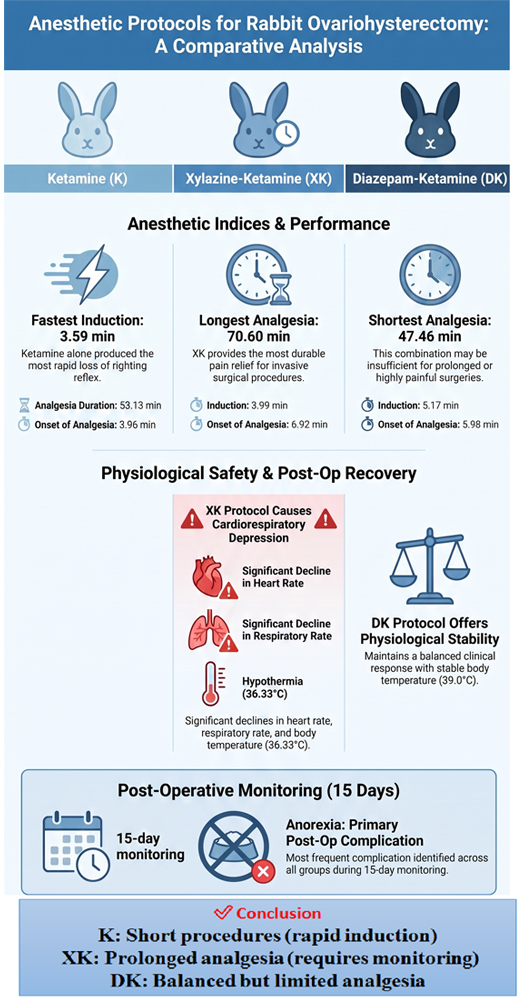
Materials and methods: Forty-five young adult female rabbits aged 7-12 months and weighing 0.5-1.9 kg were used in this study. Rabbits were randomly divided into three treatment groups, with 15 rabbits in each group. Each rabbit was considered one biological replicate; therefore, each treatment group had 15 biological replicates. The first group received ketamine at 60 mg/kg of body weight (BW), the second group received xylazine and ketamine (xylazine at 3 mg/kg with ketamine at 35 mg/kg of BW), and the third group received diazepam-ketamine (diazepam at 1.0 mg/kg with ketamine at 25 mg/kg of BW) by intramuscular injection. Anesthetic indices, including onset of loss of righting reflex (OLRR), onset of analgesia (OA), and duration of analgesia (DA), were recorded. Heart rate, respiratory rate, and rectal temperature were measured at 10-minute intervals for 60 minutes. Post-operative complications, including anorexia, hypotension, hypoxemia, hyperthermia, hypothermia, self-trauma, ataxia, delayed recovery, gastrointestinal stasis, bloat, infection, and death, were monitored for 15 days.
Results: Ketamine produced the fastest OLRR at 3.59± 0.106 minutes. The xylazine-ketamine group produced the longest DA at 70.60 ± 1.501 minutes. The xylazine-ketamine group demonstrated progressive cardiovascular, respiratory, and thermoregulatory depression, including declining heart rate ( 171.13 ± 0.52 bpm ), reduced respiratory rate (55.53 ± 0.26 bpm), and hypothermia (36.33 ± 0.80 °C). The diazepam-ketamine group demonstrated moderate physiological changes with comparatively stable body temperature (38.5 ± 0.11°C). Anorexia was the most common post-operative complication across all groups. Bloat was most frequent in the ketamine group, followed by the xylazine-ketamine group.
Conclusion: Ketamine was suitable for short procedures requiring rapid induction and relative physiological stability, such as neutering, dental scaling, tooth extraction, and catheterization. Xylazine-ketamine provided prolonged analgesia but required careful cardiovascular, respiratory, and thermal monitoring. Diazepam-ketamine offered a more physiologically balanced response.
Article Details

This work is licensed under a Creative Commons Attribution 4.0 International License.
All claims expressed in this article are solely those of the authors and do not necessarily represent those of their affiliated organizations, or those of the publisher, the editors, and the reviewers. Any product that may be evaluated in this article, or claim that may be made by its manufacturer, is not guaranteed or endorsed by the publisher.
References
Mapara M, Thomas BS, and Bhat K. Rabbit as an animal model for experimental research. Dent Res J. 2012; 9(1): 111-118. DOI: 10.4103/1735-3327.92960
Skovlund CR, Forkman B, Lund TB, Mistry BG, Nielsen SS, and Sandøe P. Perceptions of the rabbit as a low investment ‘starter pet’ lead to negative impacts on its welfare: Results of two Danish surveys. Anim Welf. 2023; 32: e45. DOI: 10.1017/awf.2023.41
Lee HW, Machin H, and Adami C. Peri-anaesthetic mortality and nonfatal gastrointestinal complications in pet rabbits: A retrospective study on 210 cases. Vet Anaesth Analg. 2018; 45(4): 520-528. DOI: 10.1016/j.vaa.2018.01.010
Pieper EG, Carter JE, Firestone SM, and Baron HR. A review of perioperative mortality in pet rabbits in Australia. Aust Vet J. 2025; 103(1-2): 3-12. DOI: 10.1111/avj.13391
Schmid ML, Werner J, Scheer M, Nölling L, Geppert C, Brill M, et al. Evaluation of different intramuscular injectable anesthetic combinations in rabbits: Impact on anesthetic depth, physiological parameters, and EEG recordings. PLoS One. 2025; 20(2): e0319106. DOI: 10.1371/journal.pone.0319106
Flecknell P, editor. Anaesthesia of common laboratory species: Special considerations. Laboratory animal anaesthesia and analgesia, 5th ed. London: Academic Press; 2016. p. 193-256. DOI: 10.1016/B978-0-12-818268-0.00010-3
Lipman NS, Marini RP, and Erdman SE. A comparison of ketamine/xylazine and ketamine/xylazine/acepromazine anesthesia in the rabbit. Lab Anim Sci. 1990; 40(4): 395-398. Available at: https://pubmed.ncbi.nlm.nih.gov/2166867/
Oguntoye CO, and Oke BO. A comparison of xylazine/ketamine, diazepam/ketamine and acepromazine/ketamine anaesthesia in rabbit. Sokoto J Vet Sci. 2014; 12(3): 21-25. DOI: 10.4314/sokjvs.v12i3.4
Longley L. Anaesthesia of exotic pets. Edinburgh: Elsevier Health Sciences; 2008. p. 36-59.
White GL, and Holmes DD. A comparison of ketamine and the combination ketamine-xylazine for effective surgical anesthesia in the rabbit. Lab Anim Sci. 1976; 26(5): 804-806. Available at: https://pubmed.ncbi.nlm.nih.gov/979147/
Borkowski GL, Danneman PJ, Russell GB, and Lang CM. An evaluation of three intravenous anesthetic regimens in New Zealand rabbits. Lab Anim Sci. 1990; 40(3): 270-276. Available at: https://pubmed.ncbi.nlm.nih.gov/2162982/
Peeters ME, Gil D, Teske E, Eyzenbach V, van den Brom WE, Lumeij JT, et al. Four methods for general anaesthesia in the rabbit: A comparative study. Lab Anim. 1988; 22(4): 355-360. DOI: 10.1258/002367788780746197
Green CJ, Knight J, Precious S, and Simpkin S. Ketamine alone and combined with diazepam or xylazine in laboratory animals: A 10 year experience. Lab Anim. 1981; 15(2): 163-170. DOI: 10.1258/002367781780959107
Walter B, Poth T, Böhmer E, Braun J, and Matis U. Uterine disorders in 59 rabbits. Vet Rec. 2010; 166(8): 230-233. DOI: 10.1136/vr.b4749
Perpiñán D. Rabbit neutering. Companion Anim. 2019; 24(4): 217-225. DOI: 10.12968/coan.2019.24.4.217
Henke J, Astner S, Brill T, Eissner B, Busch R, and Erhardt W. Comparative study of three intramuscular anaesthetic combinations: Medetomidine/ketamine, medetomidine/fentanyl/midazolam and xylazine/ketamine in rabbits. Vet Anaesth Analg. 2005; 32(5): 261-270. DOI: 10.1111/j.1467-2995.2005.00242.x
Orr HE, Roughan JV, and Flecknell PA. Assessment of ketamine and medetomidine anaesthesia in the domestic rabbit. Vet Anaesth Analg. 2005; 32(5): 271-279. DOI: 10.1111/j.1467-2995.2005.00211.x
Grint NJ, Smith HE, and Senior JM. Clinical evaluation of alfaxalone in cyclodextrin for the induction of anaesthesia in rabbits. Vet Rec. 2008; 163(13): 395-396. DOI: 10.1136/vr.163.13.395
Clauss M, and Hatt JM. Evidence-based rabbit housing and nutrition. Vet Clin North Am Exot Anim Pract. 2017; 20(3): 871-884. DOI: 10.1016/j.cvex.2017.04.006
Flecknell P. Anaesthesia of common laboratory species: Special considerations. Laboratory animal anaesthesia. 3rd ed. London: Academic Press; 2009. p. 204-212. DOI: 10.1016/B978-0-12-369376-1.00006-X
Jakhrani MY, Shah AM, Hassan MF, Laghari A, Janyaro H, Kazi AH, et al. Comparative study on anesthetic effect of xylazine-ketamine and diazepam-ketamine in rabbit model. Uni Sindh J Anim Sci. 2023; 7(3): 52-56. DOI: 10.57038/usjas.v7i03.6506
Fudge AM, editor. Laboratory medicine: Avian and exotic pets. Philadelphia: W.B. Saunders; 2000. Available at: https://catalog.nlm.nih.gov/permalink/01NLM_INST/1fua1rm/alma998999543406676
Olson ME, and Bruce J. Ovariectomy, ovariohysterectomy and orchidectomy in rodents and rabbits. Can Vet J. 1986; 27(12): 523-527. Available at: https://pmc.ncbi.nlm.nih.gov/articles/PMC1680421
Plumb DC. Plumb's veterinary drug handbook. 9th ed. Hoboken: Wiley-Blackwell; 2018. Available at: https://www.vendee-logement.fr/sites/default/files/2021-07/pdf-plumbs-veterinary-drug-handbook-pocket-donald-c-plumb-pdf-download-free-book-63a3052.pdf
Dandea ŞM, Peștean CP, Melega I, Codea RA, Bel LV, Hașaș AD, et al. Anesthetic protocols for enhancing physiological stability in rabbits during hemorrhagic shock. Vet Med Int. 2025; 2025: 6645642. DOI: 10.1155/vmi/6645642
Abduljaleel MR. Xylazine-ketamine outperforms diazepam-ketamine in rabbit anesthesia. Academia Open. 2024; 9(2): 10.21070/acopen.9.2024.9969. DOI: 10.21070/acopen.9.2024.9969
Hassan M, Abdalla M, Saber M, Senosy W, Nassif M, and ElSherif M. Evaluation of xylazine ketamine anesthesia in rabbits undergoing tendon surgery: A prospective randomized controlled study. New Valley Vet J. 2024; 4(1): 1-7. DOI: 10.21608/nvvj.2023.247402.1038
Berry SH. Injectable anesthetics. In: Grimm KA, Lamont LA, Tranquilli WJ, Greene SA, and Robertson SA, editors. Veterinary anesthesia and analgesia. Veterinary Anesthesia and Analgesia: The fifth edition of Lumb and Jones. Hoboken: Wiley; 2015. p. 277-296. DOI: 10.1002/9781119421375.ch15
Shao YR, Ke X, Luo LH, Xu JD, and Xu LQ. Application of early enteral nutrition nursing based on enhanced recovery after surgery theory in patients with digestive surgery. World J Gastrointest Surg. 2023; 15(9): 1910-1918. DOI: 10.4240/wjgs.v15.i9.1910
Marietta M, White PF, Pudwill C, Way WL, and Trevor A. Biodisposition of ketamine in the rat: Self-induction of metabolism. J Pharmacol Exp Ther. 1976; 196(3): 536-544. DOI: 10.1097/00132586-197612000-00013